4-6-11 SHORT HILLS: Today I got another load of compost from the town dump and finished the cherry tree plantings and sprinkler repair. I planted lamium around the spirea by the sundial—nine Lamium maculatum ‘Purple Dragon’ and six L. maculatum ‘Red Nancy’, and six sweet woodruff, Galium odoratum, around the quince bush.
There is a very nice, moving article about Judy’s pet therapy work that will appear in the local newspapers.
http://thealternativepress.com/articles/short-hills-residents-pet-therapy-dogs-bring-joy-to-patients-at-nbimc--2
New blooms: pachysandra.
Wednesday, April 06, 2011


Tuesday, April 05, 2011
The Last Cherry Tree.
4-5-11 SHORT HILLS: Another exciting day in the garden! It was warm this morning after a trace of rain over night. At midday a front came through with big wind gusts, heavy rain for a few minutes and a major temperature drop. By late afternoon, it was all over and the sun was out. We got 0.2 inches of rain. I was at Home Depot putting another cherry tree in the car when the rain started. This fifth and last tree, Prunus subhirtella, is now planted in the same area as the others and those dogwoods. I had to move that blueberry bush that I had previously moved a couple weeks ago. It must feel like one of Judy’s end tables.
I also bought a hose repair kit and fixed the sprinkler pipe that I cut yesterday. Earlier I stopped at the town dump and shoveled a yard of aged compost into the car which I used to fill holes in the yard. Thanks a lot, Gus.
Tonight I planted basil and tomato seeds indoors, of course. The oregano has germinated and tiny, two-leafed seedlings are just visible in the planting tray.
So many of the early spring flowers are vivid yellow—daffodil, forsythia, spice bush, marsh marigold, dandelion, trout lily—come to mind. Could it be just coincidence or, perhaps, an important color to some pollinator. With the low sun angle of early spring, maybe the yellow is better seen by insect eyes??
I forgot to mention another perennial with yesterday's list: pulmonaria 'Trevi Fountain'.
New blooms: spice bush.

Vinca minor. Not yellow.
I also bought a hose repair kit and fixed the sprinkler pipe that I cut yesterday. Earlier I stopped at the town dump and shoveled a yard of aged compost into the car which I used to fill holes in the yard. Thanks a lot, Gus.
Tonight I planted basil and tomato seeds indoors, of course. The oregano has germinated and tiny, two-leafed seedlings are just visible in the planting tray.
So many of the early spring flowers are vivid yellow—daffodil, forsythia, spice bush, marsh marigold, dandelion, trout lily—come to mind. Could it be just coincidence or, perhaps, an important color to some pollinator. With the low sun angle of early spring, maybe the yellow is better seen by insect eyes??
I forgot to mention another perennial with yesterday's list: pulmonaria 'Trevi Fountain'.
New blooms: spice bush.

Vinca minor. Not yellow.
Monday, April 04, 2011
More Planting.
4-4-11 We have had a bit more rain, hardly measurable, but more on call for tomorrow. The snow is once again gone. The days have been in the sixties and Spring is back on track.
Saturday I planted those perennials near patio by the back door: four foxglove, Digitalis x mertonensis; three variegated Jacob’s ladder, Polemonium ‘Brise d’Anjou’ USPP9781; two forget-me-not, Myosotis sylvatica ‘Victoria Blue’; and three bellflower, Campanula glomerata ‘Superba’. All of them tolerate partial sun, a pre-requisite for growing in this yard.
The pollinators are out too. I saw swarms of fresh bugs Saturday and today.
Saturday night we heard Rossini’s “Le Comte Ory” at the Met. The featured singers were Juan Diego Flórez, Joyce DiDonato and Diana Damrau. The penultimate scene has the Comte, a man disguised as a nun played by a man, in bed with the countess played by a woman and the Comte’s page a man played by a woman all in bed together. Needless to say it’s a comedy.
Today I went back to The Farm and bought two more cherry trees, Yoshino cherries, Prunus x yedoensis, and planted them in the same area as the other cherries and dogwoods. Unfortunately, I managed to cut the sprinkler system, so that needs repairing. I also got some shade tolerant ground covers, lamium and sweet woodruff to try.
New blooms: forsythia, squill.
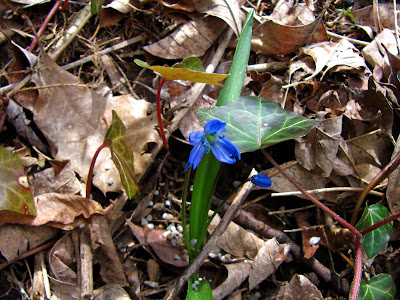
Siberian squill, Scilla siberica. This is a hyacinth-family bulb, standing tall at two inches.

A closer look at the flower, there should be six petals, I think two are stuck together at 5 o'clock. Something has taken a bite or two out of this one, probably as a bud before it opened. You can see the dark blue pollen-bearing anthers, there are four but should be six, the filaments that supported the anthers are there. The purple stigma in the center leads to the ovary.

A crocus cluster sheltering under an ash tree.

Close-up. Can you ID the same organs as above?
Saturday I planted those perennials near patio by the back door: four foxglove, Digitalis x mertonensis; three variegated Jacob’s ladder, Polemonium ‘Brise d’Anjou’ USPP9781; two forget-me-not, Myosotis sylvatica ‘Victoria Blue’; and three bellflower, Campanula glomerata ‘Superba’. All of them tolerate partial sun, a pre-requisite for growing in this yard.
The pollinators are out too. I saw swarms of fresh bugs Saturday and today.
Saturday night we heard Rossini’s “Le Comte Ory” at the Met. The featured singers were Juan Diego Flórez, Joyce DiDonato and Diana Damrau. The penultimate scene has the Comte, a man disguised as a nun played by a man, in bed with the countess played by a woman and the Comte’s page a man played by a woman all in bed together. Needless to say it’s a comedy.
Today I went back to The Farm and bought two more cherry trees, Yoshino cherries, Prunus x yedoensis, and planted them in the same area as the other cherries and dogwoods. Unfortunately, I managed to cut the sprinkler system, so that needs repairing. I also got some shade tolerant ground covers, lamium and sweet woodruff to try.
New blooms: forsythia, squill.
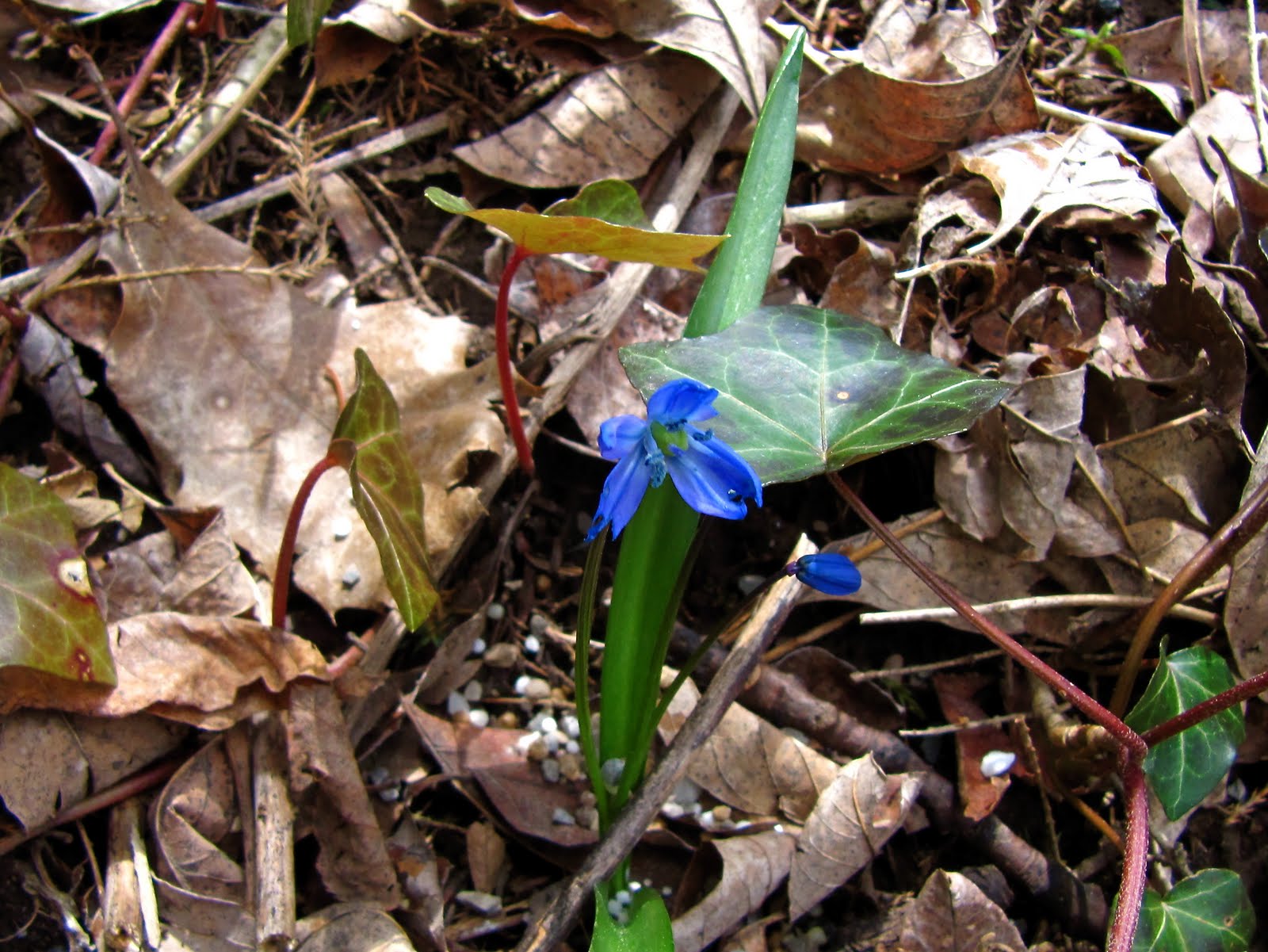
Siberian squill, Scilla siberica. This is a hyacinth-family bulb, standing tall at two inches.

A closer look at the flower, there should be six petals, I think two are stuck together at 5 o'clock. Something has taken a bite or two out of this one, probably as a bud before it opened. You can see the dark blue pollen-bearing anthers, there are four but should be six, the filaments that supported the anthers are there. The purple stigma in the center leads to the ovary.

A crocus cluster sheltering under an ash tree.

Close-up. Can you ID the same organs as above?
Friday, April 01, 2011
Fooled Us.
4-1-11 SHORT HILLS: They certainly fooled us with the Winter Storm Warning. We have had rain, less than an inch, in two days with a few episodes of snow that melted on contact. Actually the snow we had is disappearing with this rain. I hope that’s our last snow for April and the season. It’s in the thirties with no wind.
I bought two red dogwoods, Cornus florida, and a dozen perennials yesterday during the intermittent drizzle. I got hit with only a couple drops while planting the dogwoods in the area where those spruces came down. I’ll need a couple more trees for that area—more cherries, I think. The flowers are patiently waiting for planting tomorrow.
I started veggies and herbs a few days ago—oregano and rosemary, with the rosemary in the refrigerator for a faux winter for a week. In a few more days I’ll start tomatoes.
New blooms: daffodil.

This cold, soggy daffodil surely regrets the decision to open shop yesterday.
I bought two red dogwoods, Cornus florida, and a dozen perennials yesterday during the intermittent drizzle. I got hit with only a couple drops while planting the dogwoods in the area where those spruces came down. I’ll need a couple more trees for that area—more cherries, I think. The flowers are patiently waiting for planting tomorrow.
I started veggies and herbs a few days ago—oregano and rosemary, with the rosemary in the refrigerator for a faux winter for a week. In a few more days I’ll start tomatoes.
New blooms: daffodil.

This cold, soggy daffodil surely regrets the decision to open shop yesterday.
Wednesday, March 30, 2011
Where's the Lamb?
3-30-11 SHORT HILLS: Today was the warmest of the week. The last two days were cold with a biting wind, even if sunny. It clouded up tonight and the weather radar shows a new storm approaching, possibly with snow. The snow we have is slowly, slowly melting.
The cold weather has frozen Spring in its tracks. All the flowers poised to bloom—daffodils, forsythia, spice bush, squill, to name a few—have just not moved for days. If you think about it, it makes sense. The point of flowers is to attract pollinators, and the bugs, most pollinators are insects, don’t hatch out or circulate on these harsh days. So the flowers, apparently temperature sensitive, are waiting for better days for the pollinators.
New blooms: on hold....

Here's the Andromeda that I mentioned in the last post.

A couple more quilts, both feather patterns. Check out the stitching work.

The cold weather has frozen Spring in its tracks. All the flowers poised to bloom—daffodils, forsythia, spice bush, squill, to name a few—have just not moved for days. If you think about it, it makes sense. The point of flowers is to attract pollinators, and the bugs, most pollinators are insects, don’t hatch out or circulate on these harsh days. So the flowers, apparently temperature sensitive, are waiting for better days for the pollinators.
New blooms: on hold....

Here's the Andromeda that I mentioned in the last post.

A couple more quilts, both feather patterns. Check out the stitching work.

Sunday, March 27, 2011
Quilt Collection.
3-27-11 SHORT HILLS: We both drove down yesterday, and both had nice, uneventful trips. Having left the Arctic behind, we were a bit surprised to see as much new snow here as there is. We were plowed again and have about 25% of the yard covered with an inch or two. It is cold, sunny and windy here.
New blooms: andromeda, vinca minor, more crocus.
Today we went to NYC. We had lunch on Montague St. in Brooklyn Heights with Val, Maggie and Lucy, then walked the Promenade and visited the six new piers on the East River below the Promenade being developed for recreation. The project will be wonderful recapturing of the shore line for peoples’ use since all the shipping has moved to Newark and Elizabeth. The harbor is so busy with ferries and helicopters and commercial shipping and all the bridges and that special statute, you don’t know where to look first.
Judy and I went to the Park Avenue Armory, back in Manhattan, for a huge show of quilts. The show was sponsored by the American Folk Art Museum and displayed the collection of Joanna S. Rose. There are 650 quilts, all red and white, mostly from the 19th Century. The Armory has a huge display space and most of the quilts were hanging in circular arrangements. Each piece was unique and beautifully crafted, but the effect of the massed hanging is stunningly dramatic. The show is there until Wednesday if you can do it.


Each of the hanging quilts that you see is backed by a different one. Below are a couple of many I thought were special.


New blooms: andromeda, vinca minor, more crocus.
Today we went to NYC. We had lunch on Montague St. in Brooklyn Heights with Val, Maggie and Lucy, then walked the Promenade and visited the six new piers on the East River below the Promenade being developed for recreation. The project will be wonderful recapturing of the shore line for peoples’ use since all the shipping has moved to Newark and Elizabeth. The harbor is so busy with ferries and helicopters and commercial shipping and all the bridges and that special statute, you don’t know where to look first.
Judy and I went to the Park Avenue Armory, back in Manhattan, for a huge show of quilts. The show was sponsored by the American Folk Art Museum and displayed the collection of Joanna S. Rose. There are 650 quilts, all red and white, mostly from the 19th Century. The Armory has a huge display space and most of the quilts were hanging in circular arrangements. Each piece was unique and beautifully crafted, but the effect of the massed hanging is stunningly dramatic. The show is there until Wednesday if you can do it.


Each of the hanging quilts that you see is backed by a different one. Below are a couple of many I thought were special.


Thursday, March 24, 2011
Sweetness.
3-24-11 VERMONT: It’s been colder, and the snow has remained and stayed firm enough to comfortably walk around on, in snowshoes, of course. Val and Lucy are back in Brooklyn Heights, and Judy and I are figuring out how long to stay in snowland.
Judy, BTW, had a letter published in the NYT Science Section on Tuesday. Here’s the link: http://www.nytimes.com/2011/03/22/science/22letters3.html?_r=1&ref=science
I have written the NYT, perhaps a dozen times, and never gotten more than a ‘thanks for your interest’. Judy’s letter was, of course, edited to a shadow of its original self.
Across the road, they’re boilin’, turning sugar maple sap into syrup. It takes 100 gallons of sap, collected in the buckets hanging on the taps in the trees and then carried to the sugar house, to make 2.5 gallons of syrup. The sap, looking like water, is poured into the tank on the side of the sugar house from where it feeds by gravity into the maze of a large, compartmentalized, rectangular pan heated by a long, wood-fired stove called an ‘arch’. The sap moves through the sections of the pan, boiling as it goes, pushed along by the inflow of more sap. At the other end of the maze, the syrup is decanted when it has reached the right specific gravity and temperature. They boil at a rate of 25 gallons per hour. The process turns a lot of water into steam and a lot of wood into smoke, both of which are wafting out of the sugar house. Their excellent syrup is branded as ‘Winter Ridge’, but you probably won’t find it very far from Thetford, VT.

Lots of buckets and steam and smoke to make a little syrup. A sugar house has a huge cupola with sides that open to let the steam out and a chimney for the smoke.

The collecting tank is on the gable end of the sugar house.
Judy, BTW, had a letter published in the NYT Science Section on Tuesday. Here’s the link: http://www.nytimes.com/2011/03/22/science/22letters3.html?_r=1&ref=science
I have written the NYT, perhaps a dozen times, and never gotten more than a ‘thanks for your interest’. Judy’s letter was, of course, edited to a shadow of its original self.
Across the road, they’re boilin’, turning sugar maple sap into syrup. It takes 100 gallons of sap, collected in the buckets hanging on the taps in the trees and then carried to the sugar house, to make 2.5 gallons of syrup. The sap, looking like water, is poured into the tank on the side of the sugar house from where it feeds by gravity into the maze of a large, compartmentalized, rectangular pan heated by a long, wood-fired stove called an ‘arch’. The sap moves through the sections of the pan, boiling as it goes, pushed along by the inflow of more sap. At the other end of the maze, the syrup is decanted when it has reached the right specific gravity and temperature. They boil at a rate of 25 gallons per hour. The process turns a lot of water into steam and a lot of wood into smoke, both of which are wafting out of the sugar house. Their excellent syrup is branded as ‘Winter Ridge’, but you probably won’t find it very far from Thetford, VT.

Lots of buckets and steam and smoke to make a little syrup. A sugar house has a huge cupola with sides that open to let the steam out and a chimney for the smoke.

The collecting tank is on the gable end of the sugar house.
Subscribe to:
Comments (Atom)
