Thursday, October 03, 2013

Cappadocia Consumerism.

10-3-13 CAPPADOCIA: Our hotel here, Cave Deluxe, is built into the hillside and extends upwards for several levels with a succession of terraces and rooms and a very high uniqueness quotient. The main dining room is outside, glass enclosed with a central fireplace. Directly across the little valley is a tuff castle and a minaret.

We were up early as usual and off on the bus for the Goreme Open Air Museum, a series of mountainside caves that was once a monastery and orthodox churches. There are frescos, some extremely well preserved. The church ceilings were fashioned like Hagia Sophia as a several interconnected domes. In Istanbul the domes are structural, but they’re purely ornamental in the caves. There are shops near the parking, of course, and camels available for a ride or just a photo-op. Judy bought a purse.

Our next stop was the under ground city, Kaymakli, which is a vast labyrinth of rooms and interconnected tunnels all below ground. The early locals dug them out as a defensive retreat for shelter against the Romans and other marauders. They were able to live for extended periods in the holes. They could make wine, bake bread, feed livestock and attend church. There were narrow tunnels that we shuffled down while bent over at the waist. They had round slabs that they roll into the mouth of a tunnel to close it off like a sliding door. There was a ventilation shaft for air and chimneys for the kitchens.

Next was lunch at Ziggy, a restaurant named for the owner’s dog. I give it four stars for both food and ambiance. Turkish meals, if I haven’t mentioned it before, start with a bunch of appetizers, six or eight veggie dishes, on the table for sharing, followed by any or all of soup, salad or the entrĂ©e which is usually meat, often a kebab. At Ziggy it was pastrami in filo dough—nice.

Next we saw rug weaving in progress with both wool and silk, and saw the dying process for wool, and silk harvesting from the silkworm cocoons. Judy bought a rug. And then, it was potting, we saw vases from either white or red clay, and a potter threw a Hittite style vase. They have a round tubular body so the server can pour from the shoulder—we bought one of those.


Goreme fresco of St. George.

Underground city-head room, not so much.

Cappadocia Arrival.

10-2-13 CAPPADOCIA: We had breakfast at the COD in order to catch our plane to Kayseri in central Turkey for the next phase of our trip. After an hour flight we got the luggage and boarded the bus and left for Cappadocia. Kayseri is a moderate sized industrial city that has a past history as an outpost for J. Caesar, hence the name. We bused up and up to the mountains. This area was blanketed by volcanic ash and lava 10 or so million years ago and has been eroding away since then. The vegetation is sparse and the soil looks like beach sand. The striking feature of the landscape is the eroded conical columns of volcanic tuff. The columns often have a head, neck and body. The bodies, most of the column, are from the first and deepest layer of ash. The neck is much smaller vertically and more eroded indicating a less resistant mineral mix. The apex of the column, they’re called ‘fairy chimneys’, is more resistant material from a lava flow.

We did a hike in a park area called Red Valley, Kizil Cukur, through the eroded columns and walls. It rained intermittently, and we sheltered in tunnels and caves. The caves were often houses or barns, and there are doors and dovecotes and windows carved into the rock in many places, indicating extended habitation.

We did a second, shorter walk through similar formations, and then went to a caravansary from the 1200’s. It was a stop on the silk road for the caravans for an overnight stay that was safe from brigands. The fortified caravansaries were 25 miles apart, one day’s travel by camel caravan. The reason we went there was to attend a whirling dervish ceremony and a talk by one of the leaders. Then, finally, we were back at the hotel to crash after dinner.


The eroded volcanic landscape of Cappadocia-head, neck and body of the column.

Hillside with cave dwellings. More pix when the wifi is better.

Tuesday, October 01, 2013

Busy in Istanbul.

9-30-13 ISTANBUL: After an early breakfast buffet, we bused to Topkapi Palace. It is a huge complex of building in the old city, the Byzantine city that fell to the Muslims in 1453. It then became home to caliphs and was the site of government and the home of the caliphs’ harem. We saw the treasury, library, arms museum, clothing museum, clocks, and many vistas and exteriors and interiors. The extensive tour took all morning and into the afternoon before we broke for lunch at a hilltop restaurant, Zeyrekhane.

After lunch we saw the Suleymaniye Mosque, the first of several, this one for Suleyman himself. To enter the ladies need headscarves and we all need to remove our shoes. The mosques are carpeted for the faithful to pray. Inside the mosque is tiled and painted. The outside is a series of interconnected domes and minarets. We heard the faithful called to prayer at noon, late afternoon and at sundown. We also did the Spice Market, a series of booth inside a huge bazaar complex with loads of other stuff for sale, including t-shirts and souvenirs, hardware, nuts, sweets, clothes, drinks and you name it. Judy found some spices she needed. On the way to the market we stopped at the Rustem Pasha Mosque.

By now it was late afternoon and we went to the harbor for our Bosphorus cruise. We were on the water for a couple hours, cruising up the Bosphorus and seeing many palaces and castles now converted to restaurants, hotels, consulates and schools. After sundown we disembarked at our restaurant, Poisson for seafood.

10-1-13 ISTANBUL: It was another marathon of a day. We started at the Istanbul Archeological Museum, which is part of the Topkapi Palace complex. I’ll show some sculpture at some point. Then we walked to Hagia Sophia. It started as an Orthodox church in the Byzantine era, had a brief stint as a Roman Catholic church during the Crusades and finished its religious career as a Mosque. Now, having served all those religions, it has been retired to museum duty. It is another multi-domed building, huge with a big, open central space surrounded by minarets. Lunch was at a neighborhood restaurant.

The afternoon started with a brief visit to an underground cistern from the Roman era. The water is now about a foot deep and has a big population of carp and two sculptures of Medusa. We went on to the Blue Mosque, named for the blue tiles that dominate the interior. The mosques have all been different. More about today later on.


Interior of the Suleymaniye Mosque, the edge of the big central dome is at the very top of the pic.

Spice Market is a warren of small shops in a huge roofed 'mall'.

Interior of the Hagia Sophia, early Christian mosaic.

Hagia Sophia has been an Orthodox church, a Roman Church and a mosque, but now is a museum.

The Blue Mosque, so called because of all the blue tiles used inside. [Interior pic later.]

Sunday, September 29, 2013

Istanbul-First Glimpse.

9-29-13 ISTANBUL: The flight was uneventful, always a blessing. After ten hours in the air, we got to Istanbul at noon, zipped through passport entry, connected with the NatGeo guides who vanned us to the hotel, and we checked in to the Divan Istanbul. We dumped the stuff in the room and took a walk through Taksim Square and a couple adjoining streets. We peeked into an orthodox church and went back to the hotel for a pre-dinner nap. We are seven hours ahead of EDT.

On the drive from IST to the hotel, we saw a clean city with loads of plantings lining the highway, plenty of ongoing construction, and tons of people out and about on Sunday. Most of them were dressed like other Europeans including most of the women. There were some headscarves, used by about twenty percent of mostly older women. The skyline has lots if high rises and loads of minarets.

We got a look at the Golden Horn and the Bosphorus as we went by them in the van. The old city and historic buildings are in the part of the city south of the Golden Horn on the European side of Istanbul. The Asian side is mostly residential, including the home of our guide, Aydin. He and our other guide, his wife Ruya, took us to dinner at a great restaurant that served a bunch of appetizers and a main course of kabab—great. And it left us all 'stuffed'.


Taksim Square, site of demonstrations a few months ago.

Flower stall in the square.

The crescent and star.

The restaurant, we ate on that upper floor.

Saturday, September 28, 2013

Turkey Trot.

9-28-13 SHORT HILLS: We are off to Istanbul for the start of our Turkey trip with NatGeo/Lindblad.  We leave from EWR tonight. I hope I can post every day with glorious pix, but we'll see how often we get decent wi-fi at our hotels. The weather there looks pretty much like the weather here.

New blooms: English ivy.

Monday, September 23, 2013

Chagall in the City.

9-23-13 SHORT HILLS: We did another day in the city last Saturday. We went uptown to the Jewish Museum [92nd and 5th] for the Marc Chagall exhibit. Entry to the museum is free on Saturday, which was a nice surprise. There were many paintings from the WW II era with Holocaust themes.

At closing time, we went downtown on Broadway with no traffic and met Anna and saw her new apartment and met one roommate, Emily, and had a tour of the Village ‘hood. Everybody seems to be a young single, in contrast to uptown where everything was kids and strollers. Anna’s just starting her new job and enjoys a short commute on the 7th Ave subway line to Times Sq.

Expecting a short hop to lower 1st Ave for a bistro dinner with Roger and Leeza, we ran into jammed traffic, repeatedly, and it took a trying hour trying to get near the restaurant. Ultimately we parked and walked, got there, had dinner, and got back to the car just before the rain started.


Two by Marc Chagall from the exhibit at the Jewish Museum on W.92nd St. and 5th Ave.

The exhibit is free on Saturday.

Thursday, September 19, 2013

'Reflecting Absence', the 9/11 Memorial.

9-19-13 SHORT HILLS: We visited the 9/11 Memorial this morning. We drove to Jersey City and took PATH to the WTC station and followed the signs. You need tickets, available on line and at no charge, and go through TSA-like screening before entering the site.

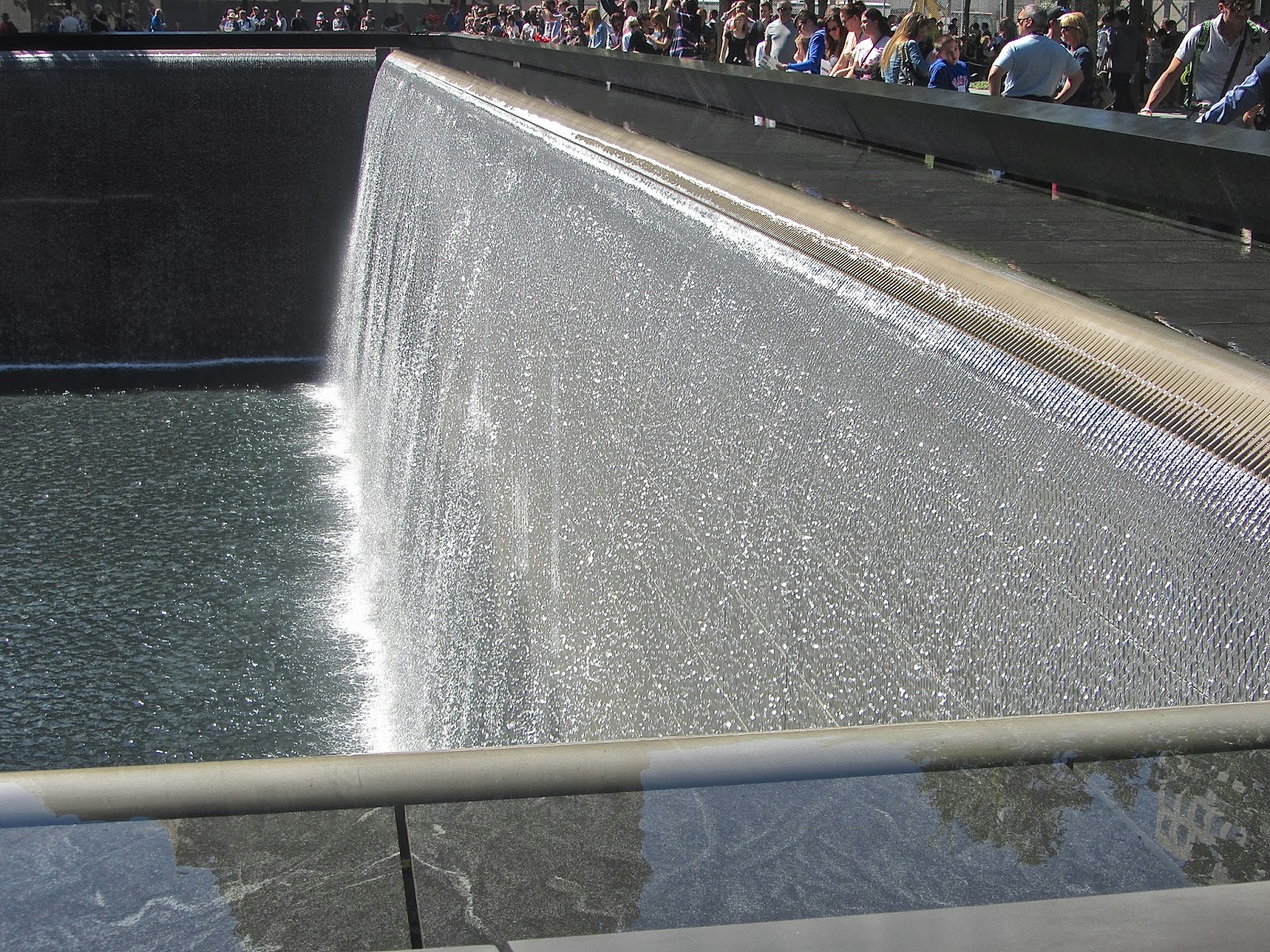
There are two huge, square reflecting pools with waterfalls on all four sides set on the footprints of the original towers. The names of the victims are on plaques surrounding the pools. An oak forest has been planted to the west of the pools. There is also a pear tree that survived the attack and has been re-planted on the site. It is thriving. The museum is uncompleted as are the surrounding buildings. Michael Arad is the architect of the Memorial.

The shell of the new WTC is almost complete. Now there are cranes and construction sites throughout the area. When all the work is done and all the fences and barriers are gone it will be beautiful. As it is, it’s very moving.

Just across Greenwich St. is St. Paul’s Chapel, a pre-revolutionary building, the ‘oldest public building in continuous use’ in the city. It literally lies in the shadow of the newest.


The World Financial Center to the west of the North Pool.

The victim's birthdays are remembered with a rose at their names.

The South Pool and crowds.

Waterfall.

St. Paul's Chapel steeple is east of the site surrounded by younger buildings from different eras.

The flag is at half staff because of the navy yard shootings in DC.

Video from the North Pool to the top of the new WTC tower, still under construction.