Friday, April 04, 2014

Desert to Mountains to Gardens.

3-28-14 FES, MOROCCO: Back to Africa. The sunrise is early in the desert, the wind was blowing harder and moving more sand and the sun was dimly showing over Algeria before we noticed it. After breakfast, we were back n the 4x4’s driving through the blowing sand that hid the road in a few spots, and rendezvoused with the bus at a different Xaluca Hotel. Xaluca also runs the tent city.


Pre-dawn with the waning crescent Moon and Venus [to the right and above the Moon] showing against the tent silhouettes.

Wind blown sun watchers.

Dim Sun.

The bus headed north through the Oases du Ziz. Leaving the desert behind us and heading back to the Atlas Mountains, the Middle Atlas on this route. There was a brief stop at Zoula overlooking a date orchard. Another stop at Er Rachidia, and a third at the Tunnel du Légionnaire before lunch in Midelt. The road climbed into the mountains, but there were not so many switchbacks and not so much geologic deformity as there was on our previous crossing. Both the roads through the mountains were built by the French to facilitate their control over the country.


Date orchard and weathering sandstone.

More sandstone.

Tunnel above the river,

Lunch at Midelt.

After lunch we descended from the pass and the vegetation began to return. First there were forests of Live Oak and Cedar, and then grassy plains with lots of sheep. We also saw lots of volcanic rock, basalt, weathered in place. The Ifrane Nature Preserve is a Cedar Forest with monkeys that eat the cedar cones. Tree poaching is a major issue. We had a short talk from a local friend of Andrew’s at the Preserve.


Cedar and Live Oak forests.

Basalt outcrops.

Lots of Sheep.

Cedar and monkey.

Ifran Park monkey getting a treat and picture.

Did mention it was now rainy and foggy? The Cedars seem pleased.

The final push to Fes took us through the city of Ifrane. It’s a prosperous, modern looking place with a private university. Fesians use Ifrane as a weekend getaway for golf and skiing. Finally Fes and the Palais Jamaï and dinner at the gorgeous hotel.


The usual tea service upon arrival.

The pool and medina from our hotel room terrace.

April Shower.

4-4-14 SHORT HILLS: I have to interrupt the Morocco narrative to do a local update. It has been in the 50’s most days and clear. There was a little rain last night. The final patch of ice in the driveway melted yesterday. The lawn guys were here while we were away and cleaned up a ton of broken bamboo. I still have some tidying up to do, but they saved me a week’s work.

Spring is slowly advancing, buds are fattening up and a few pollinators [bugs] are buzzing around.

Congrats to LuRo Gasai on winning the Scholastic Writing Award.

New blooms: snowflake, crocus, red maple, American elm.


Crocus.

Snowflakes, they're similar to Snowdrops shown before the Morocco posts.

Thursday, April 03, 2014

Midnight at the Oasis.

3-27-14 MERZOUGA, MOROCCO: It was another early morning on the bus and back on the Road of 1000 Kasbahs. We headed further east stopping briefly at Tineghir to see a primitive, but effective water transport system, an under ground aqueduct. It has now fallen into disuse, replaced by dams and reservoirs.

At Erfoud we visited a fossil store. They cut large slabs of Devonian rock from a nearby site and polish them for use as countertops, sinks, tables, etc. They also sell individual fossils, polished or not, from tiny to huge. They made a lot of sales that morning, and the bus left groaning from the load of all the extra rock. We had yet another excellent lunch in the atrium of a nearby restaurant, the entrance of which was besieged by fossil hawkers.


Erfoud fossil store sells polished and natural specimens, mostly Devonian, big ammonites in front.

Stromatolites, algal masses, were the dominant life forms of the pre-Cambrian. They ruled for eons.

We now headed south to Sijilmassa and the site of Ron’s previous dig. The site is an ancient city that was the original home of the current ruling dynasty of Morocco. There are several ancient adobe walls with the same holes that we saw in newer walls for construction form supports.


Sijilmasa dig site with ancient adobe wall built with the same technique we saw earlier.

Sijilmassa is on the outskirts of a live city, Rissani with a market place active today. It is partly enclosed and partly open air. The shoppers were engaged. Judy bought a scarf for the desert, as did many others. A few miles further down the road, we had to give up the bus for 4x4’s to go to the desert camp.


Rissani market with mysterious shoppers.

Rissani market produce delivery vehicle.

More produce.

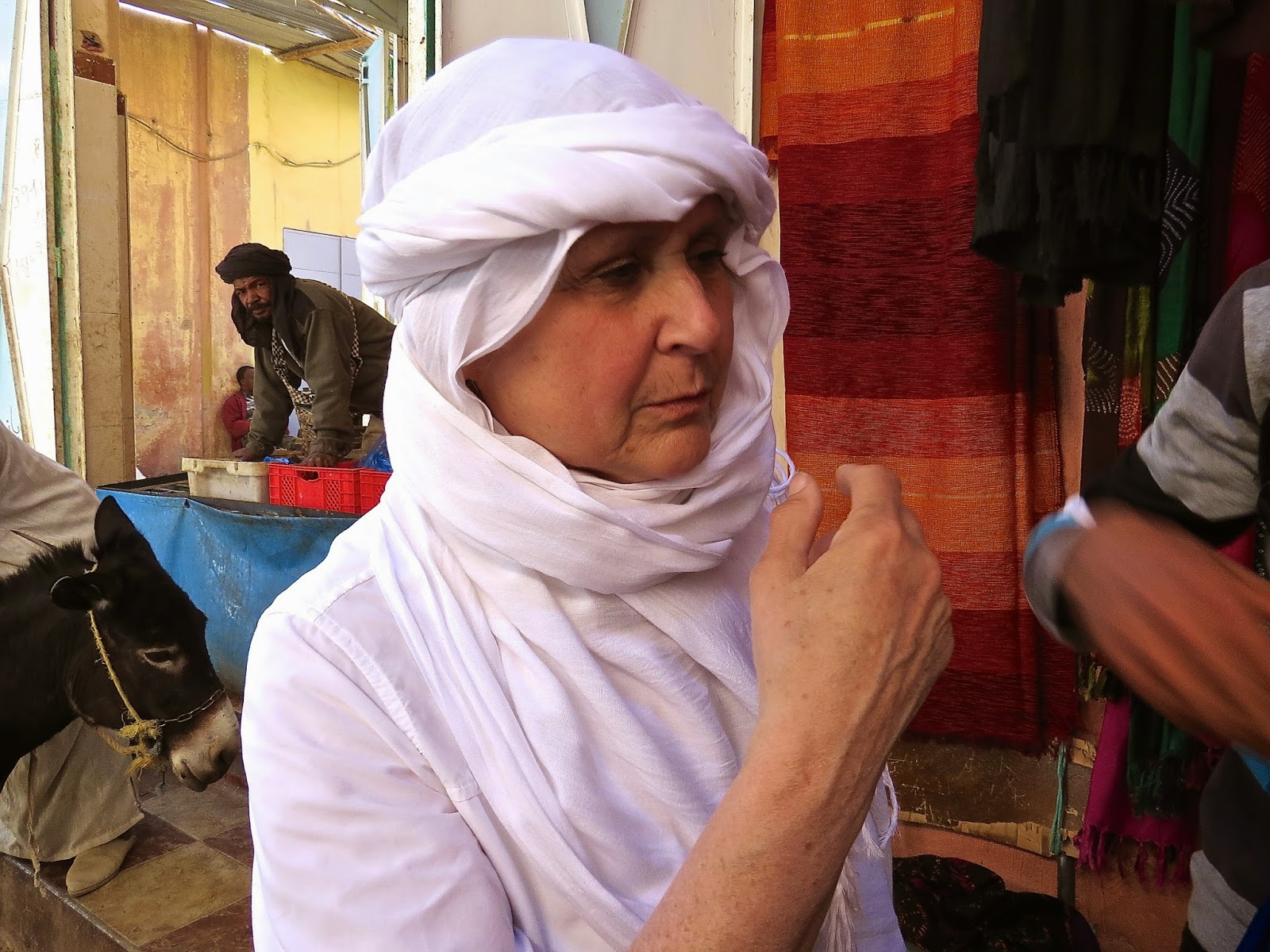
Scarfing lesson.

And more produce.

At first we drove on pavement, but later on sand, bumping and bouncing over ridges and dry riverbeds. Late in the day we arrived at the desert camp only a few miles from Algeria and on the western edge of the Sahara. The Sahara continues across North Africa thousands of miles east to the Nile valley in Egypt.

The camp is a tent city. The tents are contiguous. There is a long open corridor, floored with rugs, with bedroom tents on each side. The bedrooms have a toilet and shower, a bed covered with insect netting and a small living space, all pitch dark unless the generator is supplying power. The door is a drape. The dining room is an open tent and the ‘atrium’ is furnished with a bunch of ottomans and a firepit. All the living spaces are floored with rugs. In front of the entrance is the camel parking lot. The wind began to pick up after we arrived and the sand started to move. Anybody remember the song, ‘The Shifting, Whispering Sands’ by the Sons of the Pioneers?

We were all paired with a camel, about three camels, nose to tail, to a drover who walked us on our excursion. The camel kneels for mounting and then gets up on his/her front knees, then back legs and thirdly, front legs, throwing you back, forward and back again. About twenty feet into the ride I thought, ‘Are we done yet?’

But no, we meandered about a mile to a big dune where we climbed the steep part on foot to catch the sunset. The wind was about thirty knots at this point and it was cooling off quickly. Blowing sand turned the horizon sandy colored.

Back at the tents we had another nice dinner, the wine was flowing and a local band played for a hora-like dance. After the generator shut down, the stars were brilliant, including a couple shooting stars.


Bouncing 4x4 ride to the desert camp.

Tent city, fire pit, living room and dining room under the open tents.

Bedroom corridor, the bedrooms doors don't lock.

Dune climbers...

More dune climbers.

Florence of Arabia.

Ready to roll and drool.

Caravan silhouette.

Sandy sunset.

Dancing by firelight.

Thursday, March 27, 2014

Gorgeous Gorge.

3-26-14 BOUMALNE DADES, MOROCCO: We started the day in Ouarzazate at the Kasbah Taourirt.  It's one of former Pasha of Marrakech and feudal warlord, Thami El Glaoui's, many palaces. Our tour guide is a local who has appeared in many films. After the tour, the bus took us east on the Road of 1,000 Kasbahs. We followed rivers and went through several small towns.

We stopped a few times, once at a fossil and mineral shop that had some nice specimens, but they’re all too heavy to drag around. We arrived at Boumalne Dades in time for lunch at our next hotel, Xaluca, another gem.

We did the Dades Gorge. It’s a beautiful spot, cut out of the rock by a river and heavily settled for the water that allows agriculture. The rock in question is sedimentary sandstone, limestone and conglomerate. All of it uplifted, bent, folded, faulted, fractured and weathered. We motored for most of it, but we did walk parts where we could avoid the traffic.

Back at Hotel Xaluca, we caught Berber folk dancers, heard Ron’s last talk about an archaeological dig, Sijilmasa, that he worked on several years ago. We may visit the site tomorrow. We shared the busy hotel with German bikers and English birders. Dinner followed.


Kasbah Taourirt palace.

Cannoneers.

Palace room.

That church, top/center, with the cross is a movie set.

Movie star/tour guide.

Road of 1000 Kasbahs trip.

Fossil shop.

Dried up salty puddles.

Dades Gorge-weathered sedimentary conglomerate and sandstone looking like stacks of oreo cookies.

Dades Gorge-folded, fractured sedimentary rock. Imagining it all lying flat gives you an idea of how much compression occurred to build the Atlas Mountains.

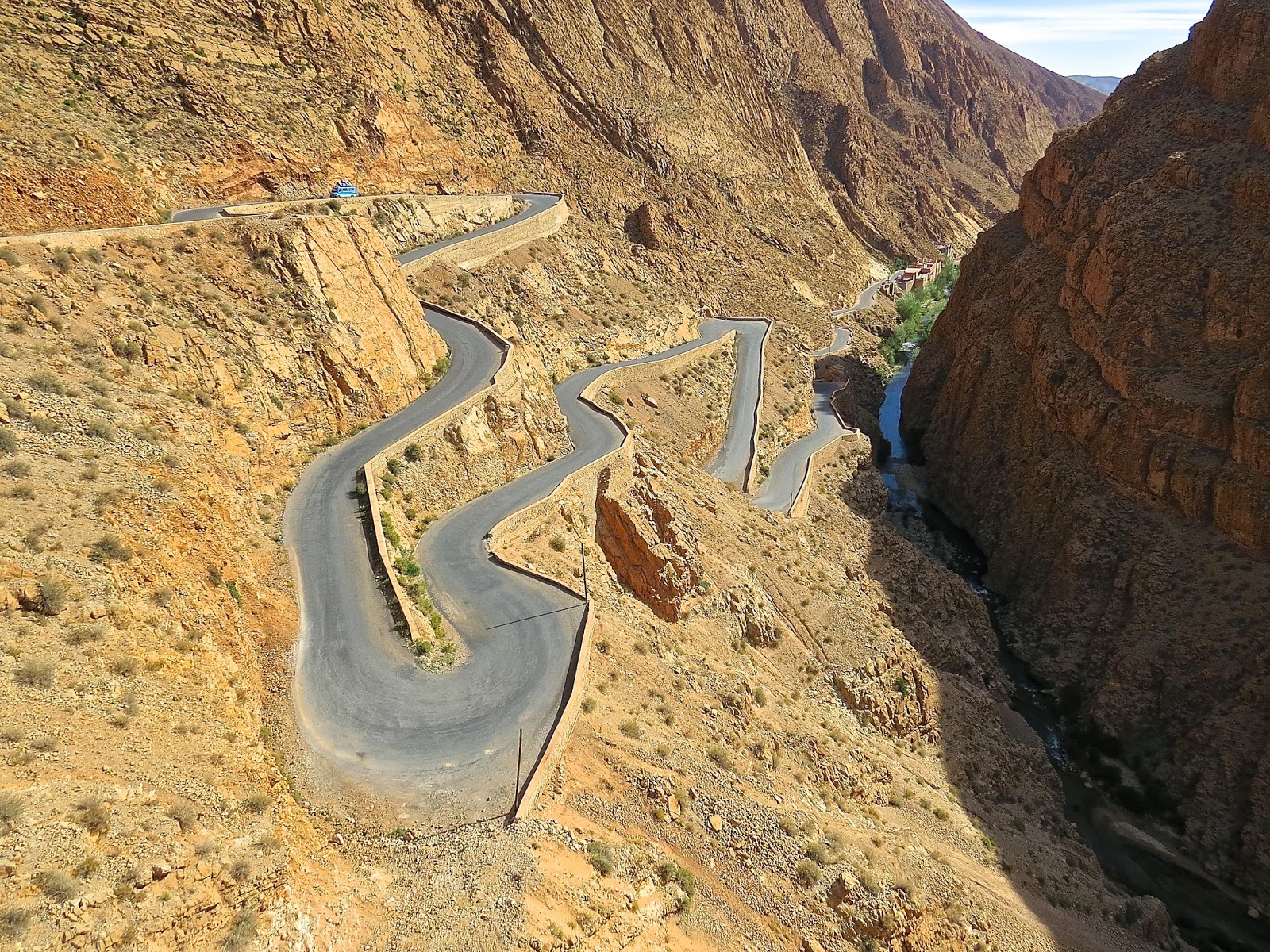
Dades Gorge-twisty road near the top. The river is at the bottom of the shadowed cliff. The rock here is all limestone.

Dades Gorge-nomad family.

Berber dancers at the hotel.

Hotel Xaluca tea service.

Tuesday, March 25, 2014

Lights, Camera....

3-25-14 OUARZAZATE, MOROCCO: We were on the bus by 8 AM heading east and then south up into the High Atlas Mountains. They were formed at the same time as the Alps and Pyrenees as part of the collision between and subduction of the African Plate with and under the European Plate. Anyway, the Atlas are tall and young and the tops are still snow capped. As the road climbed up the foothills, we noticed the change in vegetation to apple and cherry trees from the citrus trees.

In late morning, still in the foothills, we visited a Berber village and met the villagers and Peace Corps volunteers. The villagers were excited to have us visit and fed us a lunch of mint tea, olive oil,  a butter and honey mix, bread and hard-boiled eggs. We had a village tour after the spread. We also got a lot of info about the volunteers’ activities which includes, well-digging, medical care and literacy for women. There doesn't seem to be much government assistance for the rural poor. Lucy got two marriage proposals.

Back on the road, we made only a few stops for pix and wc’s, and then we were over the pass and down into the desert. On the way up, folded and fractured sedimentary strata became evident as the vegetation thinned out. South of the mountains is a rocky desert with sparse vegetation which is very different from the fruited plains north of the mountains. There are villages clustered around the rivers for the water.

Aït Benhaddou is a river village with a mostly abandoned, but picturesque old town that has been restored by movie companies. They use this area for filming desert epics. Andrew told us Game of Thrones was filming there the last time he led a trip. After lunch, another good one at L’Oasis D’or, we explored the old town, crossing the river on a beautiful new bridge. The top had great views of the green river valley and desert. Later after the ladies finished shopping, we went on to Ouarzazate, the Hollywood of Morocco.

The Berbère Palace Hotel is filled with leftover props from movies—chariots, thrones, statutes of pagan gods—all labeled as to movie of origin. Before and during dinner we met and talked with some local female university students. They have great English skills. We talked about Morocco and America and women’s issues. One of them hopes to come to the US to study journalism.


Before the climb begins...

It's still green.

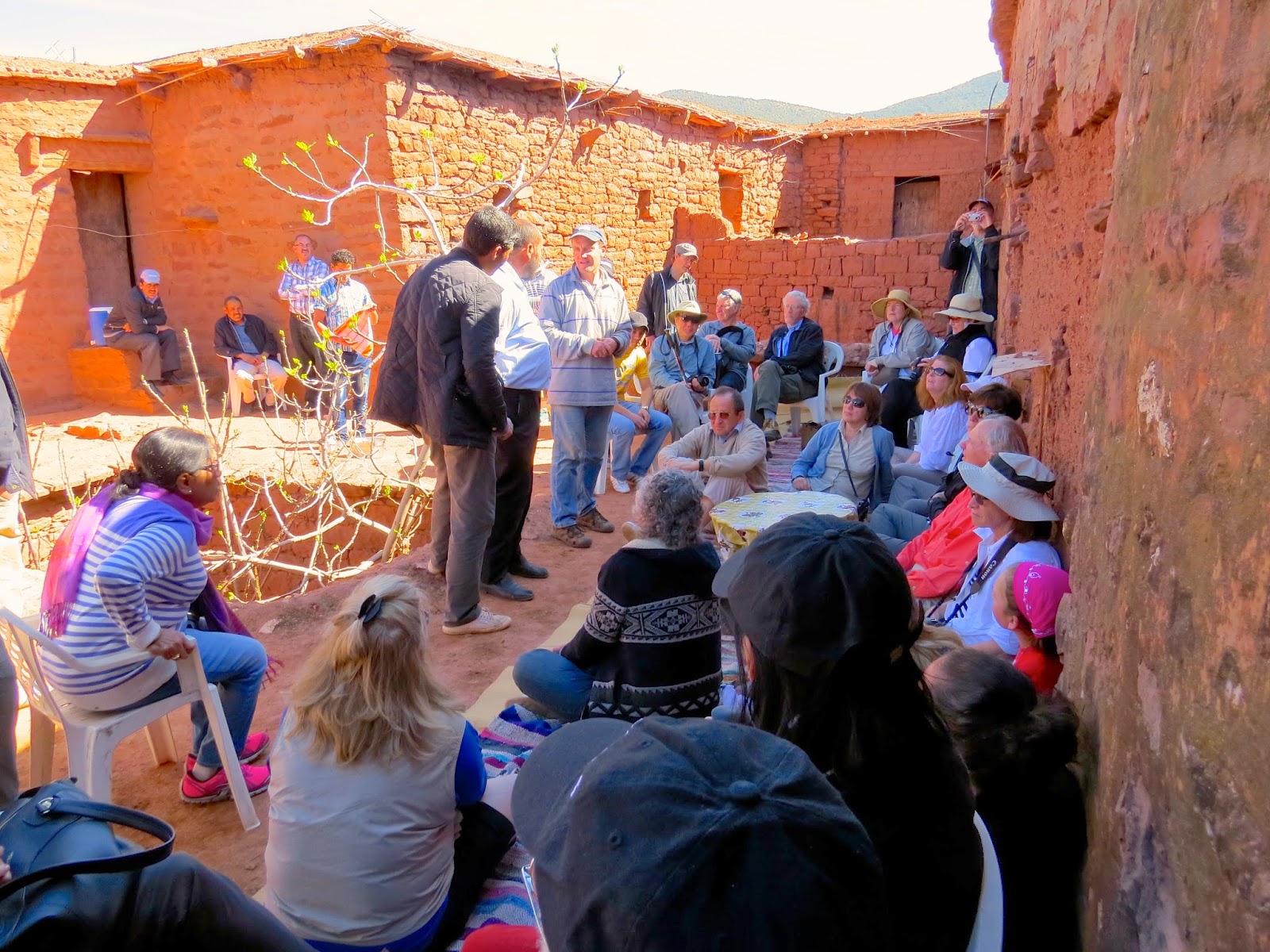
At the Berber village.

Berber village lunch.

Berber village center with the mayor.

Sedimentary strata upended...

...and folded.

Some snow near the top and green in the valley.

Near the Atlas summit, little vegetation, twisty road.

Atlas Mountains from the south, desert in the foreground.

Movie set/village of Aït Benhaddou.

White wagtail at the riverside. [thanks FM]

Top of the old town.

Atlas behind Aït Benhaddou.

Old town and river.

If there's a desert, there must be camels.

Berbère Palace Hotel with pagan god.