Saturday, May 14, 2016

Mediterranean Cruise Day VII.

5-7-16 LE PRADET, FRANCE: We are back on the European continent at a harbor in Le Pradet, a suburb of Toulon in Provence. Behind the harbor are a series of gray stone mountains that form the horizon, they all look like Cézanne’s Mont Sainte-Victoire.

This is the Côte d’Azur and people here drink rosé wine, we were informed at a visit to the Domaine de la Navicelle vineyard for a tasting of their six wines after a tour of the vines which are about to flower. They make two very different rosés for local consumption, as well as a white and two reds. I thought they all tasted pretty good.

The vineyard is neighbor to the family farm of Alizé, our expedition leader. The farm is 15 minutes by bus from the harbor. The Carrére family has owned the land since 1820, and M. Carrére is rehabbing the place and farming chickens for the eggs. About 300 chicken ladies provide almost an egg a day under an organic regimen. The chickens were all hanging out in the shade of the trees during the hot afternoon. They also have some veggies and olive trees.

We had hors d’oeuvre and wine after the tours in the courtyard of the 19th century farmhouse in the center of the farm.

After the outing, we bussed back to the ship, then docked in Toulon harbor for a photo slide show and the Captain’s Farewell Dinner. We are now headed to Monaco for a very early disembarkation and the end of the trip. We will overnight in Nice and fly out the next day.


On to Côte d' Azur and Provence. Could that be Mont Stainte-Victoire, made famous by Cézanne?

The egg business requires chickens.

Two hundred year old farm house/barn.

The courtyard where we had a reception in the afternoon.

Vineyards...

Vineyards...

Vine with many flower buds.

Jolly Parkway and Fanny Madison.

Maybe that one is Mont St-Victoire?

Farmhouse again.

Chickens in the shade on a hot afternoon.

Partial allée

Friday, May 13, 2016

Mediterranean Cruise Day VI.

5-6-15 SCANDOLA NATURE PRESERVE, CORSICA, FRANCE: We awoke to find the ship anchored in Golfo de Girolata facing red cliffs of rhyolite, a volcanic rock formed from thick lava. There were some layers of black basalt as well. We cruised these cliffs in the Zodiacs impressed by the red cliffs, dotted by green foliage and topped by cloudless, deep blue sky.

We saw, in addition to the rocks, a wild goat, an ibex, a pair of ravens circling the area, a few gulls, a cormorant and a bunch of swallows. Other than the pigeons in all the towns, that’s the extent of the wildlife we saw.

The rocks are of interest because of the striking color and because of an unusual type of erosion called Tafoni weathering which occurs when volcanic rock is in contact with salt water. It erodes the rock so that it has an odd, lacy, honeycomb pattern. We saw this process before on the Baja cruise.

Back on the ship, we had an outdoor barbeque lunch as we motored to Arone Plage, an extensive sandy beach with a resort and restaurant. Judy and I opted for the hike. Others kayaked or swam, and some had a bus tour of the area. We bussed through the high village of Piana to a trailhead where we walked with a guided group across the top of a calanque, the red rock formations that jut out into the sea and bracket the steep canyons and the bays. The views and rock were dramatic. The trail had a lot of up and down over rock outcrops. The little village of Piana is picaresque but we only saw it from the bus.

The bus took us back to the beach where the Zodiacs took us back to the ship for dinner.


Scandola Nature Preserve, Corsica. No more limestone for today. These red rocks are rhyolite, a kind of lava usually containing a lot of water and compressed gases that expand after eruption accounting for the holes and pockets in the rock.

A pair of ravens above the cliffs.

The dark rocks are basalt mixed in with the rhyolite.

Bands of red and gray rock offset by a fault. The diagonal line running from the lower left to the upper right is the fault, and the mass of rock above the fault has moved downwards and to the left. Focus on the two stripes of gray and red above and below the fault to see the offset.

This lace-like appearance is due to an unusual type of weathering called Tafoni weathering that causes the rocks to have a honeycomb like feature. That vertical tan rock toward the left of the photos is a vein of new rock squeezed into a gap between the red rocks on either side of it.

An ibex under that tree. They are a wild, mountain goat with impressive horns.

Distant mountains in central Corsica with snow. The highest peak is almost 9000 ft.

Lunch with ship friends.

On our hike the rugged, craggy rock and views were awesome....


This steep canyon is formed between two calanques, land masses that extend into the sea.

The little village of Piana, high up on the mountains. We were pressed for time and didn't get to visit.

Thursday, May 12, 2016

Mediterranean Cruise Day V.

5-5-15 BONIFACIO, CORSICA, FRANCE: We were docked in the harbor, literally, at the crack of dawn. In fact a lot of us were up at 6AM for the sunrise in Bonifacio. The harbor is long and narrow and sits in a ravine with tall, chalky-white limestone cliffs on each side. The town sits on top of the western cliffs. The upper town is called the Citadel. The town walls are largely intact and dotted with round forts at regular intervals. There are also lots of shops and restaurants at the harbor level. The sun put in an appearance at about 6:20.

After breakfast, we caught a tourist ‘train’ ride up the hill for a tour of the town. It is another one with narrow, twisting streets lined by stone, stucco buildings, a bunch of churches, a military statue, many bistros and souvenir shops. None of the streets are level, everything is either up or down and some of the streets are stairs. The east side of town cliff has stairs and a road with sharp cutbacks for access, but on the west side of town cliff is precipitously steep. The town is only a few blocks wide, from cliff to cliff. There are great views in every direction of the white, limestone cliffs and the sea and Sardinia in the distance. Several massive chunks of limestone have fallen from the cliffs into the sea.

We followed our talky guide for a while before sneaking off on our own. The less settled areas of town have profuse beds of wild flowers, especially around the cemetery. Eventually we walked down the cliff on several different sets of stairs that dumped us out near the ship in time for lunch.

After lunch in the sun on the afterdeck, we had a Zodiac cruise of the cliffs and saw them from the water. There were numerous caves and grottos, very clear water, and the several huge hunks of cliff that had fallen into the water. We saw a group of teens, some of whom dove into the water to impress us from chunks of cliff a few feet above the water. We were impressed a little. Before getting back to the ship, we met a Zodiac staffed by the ship’s bartenders anchored in an inlet with a pretty beach. Strawberry margaritas were served to the thirsty.

Dinner was at a harbor-side restaurant, Di Passano, with a wine tasting and a tapas style meal. We were entertained by a six man, polyphonic a cappella group, Le Choeur de Sartène, doing traditional music.


Bonfascio, Corsica, France harbor awaiting sunrise.

Sunrise at the Citadel in Bonfascio on top of the cliff, but not down at the harbor yet.

Uphill street or downhill street, depending.

Obligatory military-triumph statue.

Downhill street

Limestone cliffs.

Limestone bedrock erodes easily making inlets with white, sandy beaches.


The citadel and walls.

Wild poppies.

Cliff divers.

Does that last house look like a good investment?

walkway on the cliff near the water.

Wednesday, May 11, 2016

Mediterranean Cruise Day IV.

5-4-16 ALGHERO, SARDINIA, ITALY: We cruised overnight and through the morning headed eastward leaving Spain behind and entering Sardinia and Italy, specifically at Alghero, in the northwest corner of the island. The planned Zodiac trip to Neptune’s grotto, a big cave eroded out of the limestone bed rock by sea action and rain, had to be cancelled because of sea conditions. We opted to send the afternoon walking around Alghero, dropping our gracias for grazie.

The city is on the edge of the sea with a long sea wall extending into the bay to create a sheltered harbor. The sea wall was part of the town’s fortifications. They display old cannons and catapults inside the wall. There are also lots of outdoor cafés and restaurants along the street just inside the wall.

Extensive beds of a purple succulent flower grow on and out of the wall. In one spot, in front of a restaurant, the beds cover the whole front yard and were visible from the ship. We saw lots of churches, entered a few. We shopped for earrings, Judy, gelato, both of us, T-shirts, Judy, and walked the narrow streets and broad avenues and the harbor.

At about 5 PM we Zodiaced back to the ship, and soon set out for Corsica. In the old days before the Euro we would have had to change our dollars for pesetas, then liras, and then francs.


Alghero, Sardinia from the sea.

Walls and flowers,

A chance to buy some red.

Tiled dome.

Under the dome.

Sea wall and purple succulent.

The town folks must feel quite secure with defensive machines like this catapult.

Two forts and the old town.

Is that too much purple? This yard was visible from the ship.

Gelatateria,

The oldest parts of the wall need work.

Tuesday, May 10, 2016

Mediterranean Cruise Day III.

5-10-16 SHORT HILLS: Everything in the yard is leafing out. Yesterday afternoon was hot and last night cool.

New blooms: ajuga, Siebold viburnum, double file viburnum, first rhododendron, chestnut, bridal wreath spirea, columbine.

5-3-16 MAHÓN, MENORCA, SPAIN: While Judy went on a hike labeled as moderate that turned out to be hard, I stayed on the ship dealing with a gastroenteritis that cleared up almost as soon as the ship emptied out. All the other explorers went on various activities. I had the morning to catch up on crossword puzzles, help the captain steer the ship when I was on the bridge, and take some pix of the journey from Ciutadella on the western end of Menorca to Mahón on the eastern end. Mahón is about a mile up an estuary from the coast through heavily settled newish neighborhoods. We motored to the dock at the base of the old town.

The whole southern half of Menorca is limestone [and possibly some dolomite] uplifted when the African plate collided with and subducted under the European plate, thereby lifting it upwards. This tectonic interaction created the Betic Cordillera, mountains of southern Spain, of which the Balearic Islands are the eastern extension. Limestone is the stuff of coral reefs, and so is formed in the ocean and dissolves, very slowly, when raised up out of the water. In the air, rain and waves eat away at the limestone and create caves and ultimately canyons.

Mahón is located atop large limestone deposits, guesstimate 100 feet high. The center of the old city is reached by successive flights of stone steps from the water’s edge to the city streets, going up a canyon in the limestone. There are somewhere between 107 and 150 steps depending on which way you go. After the ship docked at the base of the steps, I climbed to the town.

Mahón, old city, is a sleepy, sun-drenched town of pastel buildings with shuttered windows at mid-day. All the ground floors are shops selling all the stuff tourists buy, like the T-shirt I bought. There are Romanesque churches, crumbling fortifications, an opera house, narrow, cobblestone streets, an old town hall, plaças, museums and lots of outdoor bodegas. After a couple hours of wandering and watching the birds from the heights, I went back to the ship and found and joined Judy and part of her hiking group heading off for an archeological visit to Talaiòtic sites a short bus ride away.

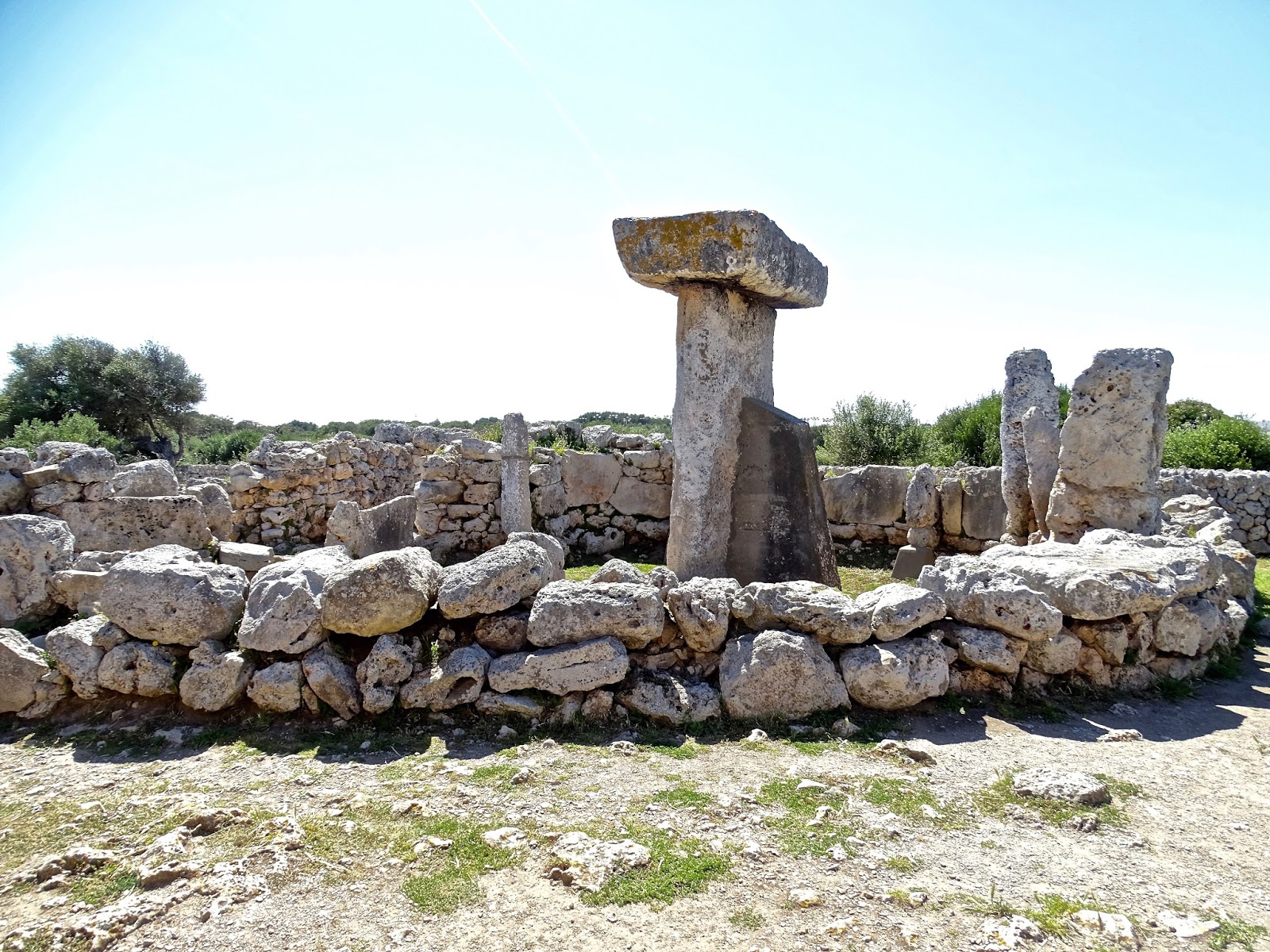
The site is up country in the midst of farms and olive groves and many limestone walls. Fallow fields are full of wild flowers. The Talaiòtic Culture existed during the Iron Age and left limestone mounds built of boulders, twenty or so feet high and fifty feet wide of unknown function. There are standing stones capped with horizontal slabs and remains of circular houses. The site we were at held perhaps 500 people.

Finally we were back at the ship for dinner and set sail on to Sardinia. There was a nice sunset. Judy and I and Australian friends Melanie and Dale dined with Craig, the ship’s Hotel Manager. During dessert, we revealed our porn-star names, which are derived from the name of one’s first or favorite pet and the name of a street lived on in childhood. I became Jolly Parkway, which caused extreme hysteria at the table and Craig got me a new nametag for my new alias.


Mahón waterfront and town atop the limestone cliffs on both sides of the picture. The gap in the cliffs, erosional in origin, allows the stairs and road to climb up to the town.

From the top of the climb, the Orion in the harbor.

Back-lit organ.

Theatre muse draws some attention.

One of several little plazas amid the pastel buildings.

Another plaza paved with limestone.

A different church interior.

From Judy's hike - limestone  and clear water, lots of little caves at the water level.

A beach on the hike with native fauna.

Menorca Talaiòtica, entrance to the site with limestone wall and great gate.

Talaiòtica stone mound of unknown function, perhaps watch tower or storehouse?

Talaiòtica standing stones and cap, all of considerable mass.

Wall, reconstructed, and olive tree, probably as old as the site.

Limestone erosion along the coast. Remember: all the limestone in these pix was formed under water and later uplifted.