Friday, May 03, 2019

Molnticello and Charlottesville.

5-3-19 WASHINGTON, VIRGINIA: Last night we had dinner in Flint Hill at the Blue Door Kitchen. We ate outside on the deck. The hip waiter picked right up on the fava bean reference and said he had an excellent Chianti to go with them. The meal was fine and less intimidating than the previous night’s marathon meal.

This morning we had another great breakfast at the Inn—yogurt, fresh fruit, granola, croissants, juice and coffee. We were on the road by midmorning headed for Charlottesville and Monticello, about an hour away. Traffic was light and we rolled through rural, pastoral Virginia, passing pastures bordering forested land, lots of cattle, mostly black angus, horse farms, small villages and four-rail fences paralleling the road and marching up and down over the hills and valleys. The countryside has gentle hills with streams between the rises and the Blue Ridge Mountains to the west.

As we neared Charlottesville, it became more suburban. Monticello, Jefferson’s plantation, is just outside the city on top of a mountain. We had tours of the gardens before our house tour. It was all very interesting. Jefferson was brilliant and innovative, but was a man of his times. He wrote of ‘life, liberty and the pursuit of happiness’ in the Declaration of Independence, but owned slaves and fathered the children of slave Sally Hemings, his diseased wife’s half-sister. His life has much to admire and much to condemn.

He was quoted as saying, late in life, that he was an old man, but still a young gardener. I assume he meant that he had yet much to learn about gardening. I empathize.

After Monticello we went to visit the U of VA. The campus by the Rotunda, which looks like Monticello, is green and brick and swarming with white columns.

Back in Washington, VA we ate at Tula’s a block away from the Inn. There was a T-storm while we ate. The food was great. Back to NJ tomorrow.


An Eastern Bluebird visited Monticello while we were getting a lecture on the gardens.

The front of the house seen throiugh the trees.

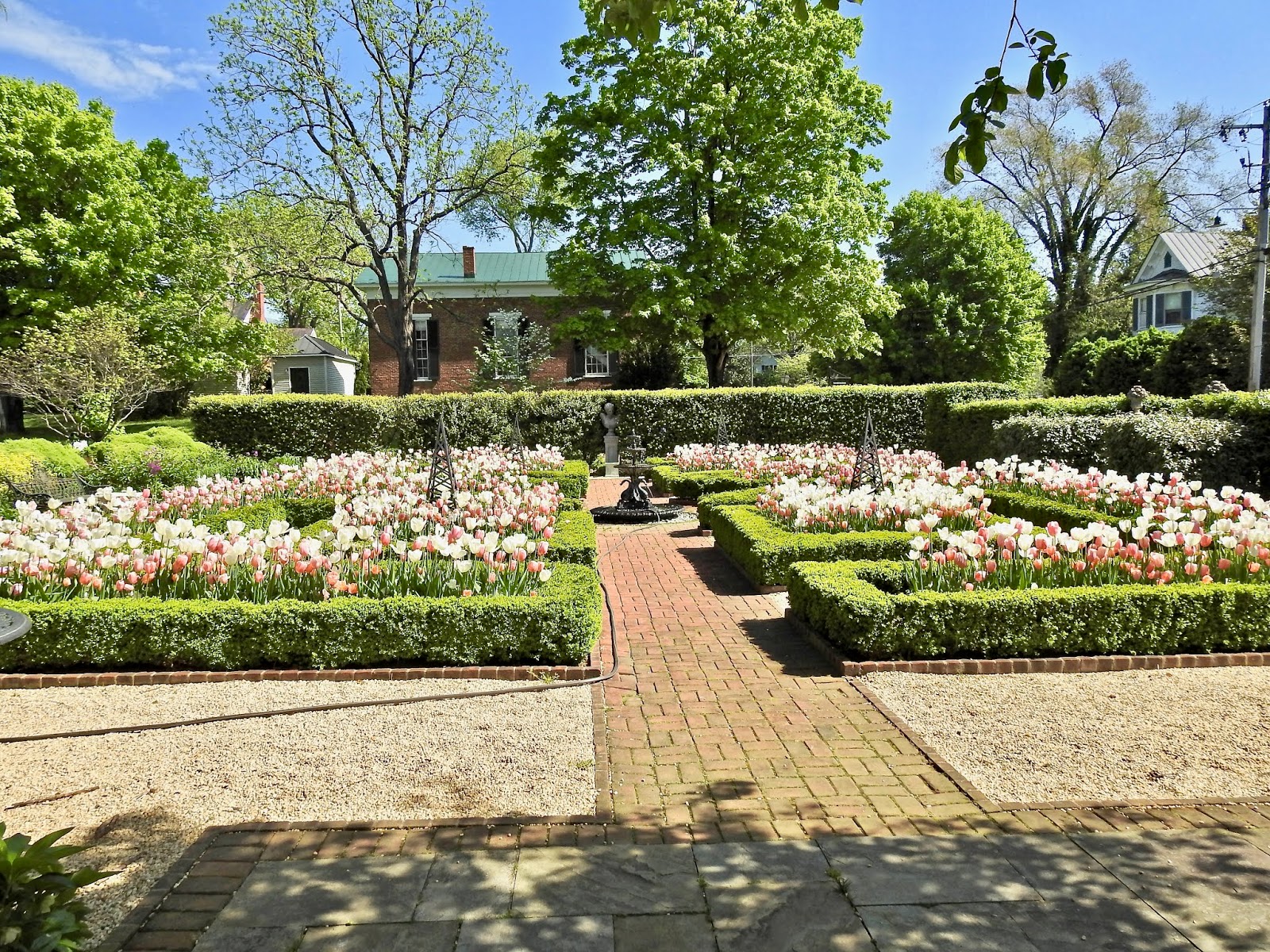
The back of the house overlooking the big back yard encircled by a winding garden path. The tulips are mostly done and the tulip bulbs are being dug up and annuals are being planted. They give away the tulip bulbs after they are pulled.

A huge linden tree near the entrance to the house. There are many huge trees surrounding the garden path, some native and some exotic.

The back of the house opens onto the garden path.

Veggie gardens have a southern exposure.

The U VA rotunda. Does it have a familiar look?

U VA green is surrounded by many, many columns.

Thursday, May 02, 2019

Three Star Dinner.

5-2-19 WASHINGTON, VIRGINIA: We drove through NJ and PA and then through a corner of WV to get to northern VA and the Inn at Little Washington. The trip took about five hours, the traffic was OK. Our greeting was very hospitable, we were expected, no paper work was needed, champagne cocktails were passed out, the luggage was brought to the rooms while we had the tour.

Judy and I did a brief walk before dinner and saw the tulip gardens, sheep pasture, veggie garden and koi pond.

Dinner options were from three tasting menus, mix and match were allowed. The food was spectacular including amuse bouches and intermezzos, all served with wine pairings. We rolled upstairs after the meal. The Inn is justly famous for the food, and it has three stars from Michelin. Michelin says three stars is worth a journey to the restaurant.

Today the four of us set out in the car after walking all around the town. Washington, VA has lot of restored houses, restored to a sort of high-end colonial style, and consists of only a few blocks, all well landscaped. There are some stop signs, but no traffic lights. After about an hour, we headed for the next town, Sperryville, not as tony as Washington. We visited shops in both towns.

After Sperryville we headed up the road to the Blue Ridge Mountains and Shenandoah National Park. We drove some of the Skyline Drive south to the restaurant at Skylands. The restaurant was spacious, with simple food and great views. On the way we stopped at several overlooks for gorgeous vistas. At one stop we saw a black bear up a tree eating new leaves.

Dinner tonight to be scheduled.


On Skyline Drive in Shenandoah National Park, we stopped at several overlooks for beautiful vistas. At one we saw a black bear up a tree.  We thought he/she was eating the new leaves.

Lobby of the Inn at Little Washington. The whole place has a Victorian look.

The front of the Inn.

Tulip beds at the Inn.

Terrace with flowers and a Koi pond.

Overlook from Skyline Drive atop the Blue Ridge Mountains.

Another bear shot.

Tuesday, April 30, 2019

Early Bloomimg.

4-30-19 SHORT HILLS: I see definite, new bud growth on one crape myrtle and possible bud swelling on the other three. It’s been rainy and cool, but the sun came out this afternoon and it’s in the sixties. The late-to-open trees—ash, locust, catalpa, linden, walnut, sycamore—are all showing leaves.

We are off to Virginia for the weekend tomorrow with Bill and Lynn to the Inn at Little Washington.

New blooms: Korean spice viburnum, azalea, beech, sweet woodruff.


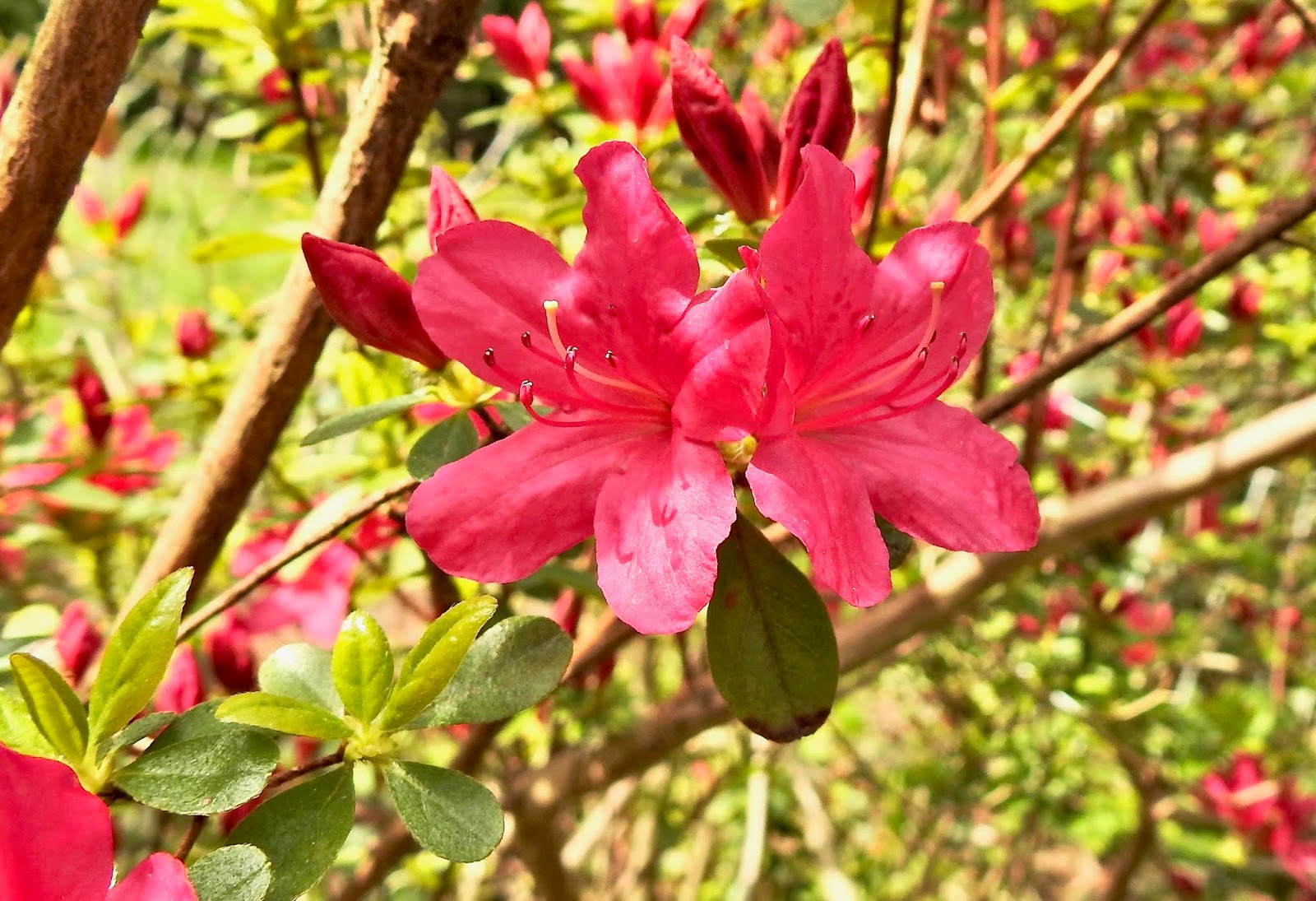
Azalea, first flowers on the first bush. Last year first flowers were on May 12.

Korean spice viburnum is an early bloomer, although usually not this early. It's very aromatic-good, but doesn't make seeds-bad.

Hemlock. You can see last year's cones in brown, one old cone from two years ago is dark brown, and new, small cones, just starting, in green. The new cones will need pollination by those yellow clusters to produce seeds. There is a twig bud starting to open near the lowest new cone. The cones are always on the end of the twig. They are pollinated by wind.

Copper beech. The tree has flowers of two sexes. The male, pollen-making, flowers are hanging down, and the female flower is the purple, prickly-looking one above the new leaves that will become the beechnut. They are pollinated by wind. Wind pollination means the plant doesn't have to provide colorful flowers, perfume, or nectar for the bugs.

Friday, April 26, 2019

A Rainy Day.

4-26-19 SHORT HILLS: It’s a nice rainy day today, so I’m inside looking outside. We just had some rumblings of thunder and Kaley the dog is upset in spite of the CBD.

I am still busy doing more pruning. Now that most of the shrubs are in leaf, I can see the dead stalks and cut them out, which makes room for new growth. Everything is showing life except for the four crape myrtles. I know that they are always late risers, but really, it’s almost May. It would be surprising if they all died, but not impossible.

One dogwood and two caryopteris are dead, a yellow twig dogwood and a weigela are struggling, but alive. One pleasant surprise is a volunteer chestnut tree growing near the road, but under the utility wires. I will have to move it to prevent it from being trimmed by the utility crews. I’m deciding where it should go, depending on what dies and whether the spot is roomy enough for a tree to grow.

New blooms: yellow lamium, purple lamium, Virginia blue bells, blueberry.


Purple lamium. These are not simple flowers. The purple above and the yellow below have an umbrella-like upper petal with the pollen on  its underside, and a landing platform petal below for the pollinator seeking nectar from the center well.

Yellow lamium. Two flowers in profile and one full face. The pollinator carries pollen from flower to flower on its back.

Blueberry flower is a white bell, similar to andromeda, leucothoe, and lily-of-the-valley.

Virginia blue bell, another woodland ephemeral.

Monday, April 22, 2019

Greening Up.

4-22-19 SHORT HILLS: We had a fast trip back to NJ, somehow avoiding Easter traffic. The snow piles in VT were much smaller after two days of warm rain, and wherever the beds became snow free, perennials started appearing.

Spring is much advanced in NJ—leaves are visible on the oaks, beech, tulip tree, elm, hawthorn, walnut, chestnut, catalpa, maple, magnolia, but the ash and locust are still hesitant. There was 1.6 inches of rain while we were in VT. We are getting more rain today. The grass is growing and green.

New blooms: dogwood, Kwanzan cherry, quince, apple, dandelion, bleeding heart, more daffodils.


Dogs are ready for the trip back to NJ. Bally is the black and white mound on the back left. Do they look happy to leave VT?

Considerably reduced snow piles after two days of warm rain.

Frog eggs two days after the ice melted.

I know it's an object of universal disdain, but it's actually a beautiful flower.

Kwansan cherry blossoms appear as the Yoshino cherry flowers are fading.

Daffodil--pretty in pink.

A political statement.

Saturday, April 20, 2019

Rain Melts Snow.

4-20-19 VERMONT: We had another day of hard rain and the snow piles are much reduced in size. It was in the sixties. There was some early sun, but the skies closed up and drenched us. We were out running chores with the dogs. I had hoped to start playing pick up sticks, but there was too much rain.

I did walk around the pond early and the frogs have already left blobs of gel filled with eggs on the edges of the pond. One turtle was on the bank most of the day trying to catch some sun. I guess the air is now warmer than the bottom of the pond.

New blooms: red maple.


Beds awakening after the snow is gone.

Perennials pop up as the snow recedes.

Snowdrops are all over.

With the pond melted, this turtle is catching some rays.

Froggy going courting.

Friday, April 19, 2019

Spring Begins in VT.

4-19-19 VERMONT: We’ve been here since Wednesday. There are huge piles of snow and ice under the eaves and at the end of the driveway. These are the places where the shoveled and plowed snow accumulates. These piles turn to ice at the bottom and last forever, or at least until May. The rest of the yard and pasture are mostly free of snow. The ground is wet and the grass matted down when the snowmelt is recent, and the grass is showing a little green where the snow has been gone for a longer time.

The pond has melted around the sides, leaving a big floating island that the wind blows around. By today the island had vanished and the frog opera has started.

Neighbor Andy took his farm equipment out of the barn a month ago when the ground seemed frozen so that the tractor wouldn’t make ruts in the newly graded pasture, but one small section in front of the barn did get rutted. Today he and I worked on the ruts and flattened them out pretty well with a tamper. Later Judy and I limed, seeded and hayed the area. It’s getting rain tonight. There’s a big frost heave under the barn and the center of the floor is raised up about a foot. I’ve done a bunch of other chores, mostly undoing the winterization I did in the fall.

One thing about this time of year is the sight lines. The snow has gone and the leaves aren’t out yet and the grass hasn’t grown tall so one can see into the woods and see the shape of the land and the terrain.

There were a pair of mergansers on the pond for a few minutes, and I saw an Eastern bluebird both yesterday. The bluebird was incredibly blue. Sorry, no pix.

In the parts of the beds that are snow free, plants are poking their heads up. The snowdrops are everywhere. Hellebore are starting to flower and daffodil have flower buds.

New blooms: snowdrop.


Massive snow piles under all the eaves will take weeks to melt and give me access to the flower beds.

Most of the snow cover is gone from the pasture and woods.

More snow and ice piles.

Broken branches litter the yard, literally thousands of them have appeared with the snow gone from the yard.

The pond has started to melt. It has a large floating island that blows around.

Snowdrops pop up through the debris and snow.

Two days later the island has lost much of its real estate. A few hours later it was only a memory and the frogs have started singing.