Monday, February 04, 2019

Costa Rica Trip V.

1-26-19 LA FORTUNA, COSTA RICA: We left Senda early and drove to Rio Chiquito on the southern shore of Lake Arenal, three hours, through farmland--dairy, beef, sugar, coffee, and little villages on dirt roads that were mostly in bad repair. Driver Jordan handled the potholes and washouts well. Every village has three things—a Catholic church, a school and a soccer field. Usually there’s a cantina, they’re called ‘sodas’ because that’s what they sell. Driving is on the left, except when you’re on the other side of the road to avoid a pothole.

We and transferred from the van to a small ferry that motored us across the lake to the boat landing by the dam at the eastern end of the lake. The lake was man-made for electrical generation. There were relatively few houses on the lakeshore, but lots of egrets, one heron, one anhinga, many cormorants. We saw the Arenal volcano with its top in the clouds.


Our ferry boat.

Great egret, yellow beak, black legs.

Neotropical cormorants. the one in the middle is getting fed by mom.

Volcanos at the eastern end of the lake, Arenal on the left. The clouds are hiding the tops.

Costa Rica uses hydroelectric, hydrothermal, solar and wind generation and has almost reached a goal all renewable energy. They hope to be carbon neutral by 2021. We were picked up by driver Alvin and taken to the nearby, Lost Iguana Resort, and checked into a beautiful room in the lavish resort.

Sumptuous room opens onto a patio with many flowering plants.

That afternoon, we did a hike in Arenal National Park up the side of the Arenal volcano with guide Luis to the site of the lava flow from the1970’s. It was rough terrain for walking and fairly high up, fortunately, we paused often for bird pix. At the base of the volcano there were educational demonstration of growing sugar, coffee, fruits and veggies and a tilapia pond.

Arenal with sun through the clouds and old lave flows on the side.

Tropical king bird.

"I'd like to buy a vowel."

Geezers at the top of the hike through the lava flow from the 1970's, only a little ways up the mountain, but enough for us. The path was strewn with rocks and gravel.

Looking out at the lake

Montezuma oropendula. A large bird, an oriole, that builds hanging nests.

Crested guan is larger, a turkey-sized bird.

Red-lored parrot.

Dinner was at the Lost Iguana Resort Blue Hibiscus restaurant.

Sunday, February 03, 2019

Costa Rica Trip IV and NYPhil.

2-3-19 SHORT HILLS: We were in the city for a NY Phil concert last night. They opened with Mozart’s Symphony No. 1, composed when he was 8 years old, and closed with the Jupiter, Symphony No. 41 his last. In between Emanuel Ax played Haydn’s Piano Concerto in D major, and after halftime, Stravinsky’s Capriccio for Piano and Orchestra. We had dinner with Sarah and Jon at Bar Boulud before the concert.

Back to Costa Rica—Day IV…

1-25-19 MONTEVERDE, COSTA RICA: We had an early bus ride to the Monteverde Cloud Forest Reserve at the top of the mountains. We were led by our guide, Tony, on a walk across many hanging bridges that spanned deep gorges. The tour had a lot of up and down and crisscrossed the continental divide. There was dense forest growth, some of it primary forest. It was cool, misty and foggy with occasional drizzle. There was a huge diversity of plant species, and even bigger diversity of epiphytic growth on the trees.

Hanging bridge through the forest canopy.

Tree covered with a epiphytes.

Tony demonstrating a flower stalk. The flowers open sequentially from the top downward. The long flowers, open in the middle of the stalk,  are evolved to be pollinated by hummingbirds.

The clouds dipped in and out of the forest.

Trees with plant friends, or enemies, from a bridge.

Canopy from a bridge with clouds settling in.

A bridge from lower in the gorge.

We saw the Resplendent Quetzal, a dramatic bird, two males, blue-green with long tails, in flight and a female eating in an avocado tree. It is harder to spot the fauna here because of the density of the flora. Tony showed us an orange-kneed tarantula.

The female Quetzal in an avocado tree. Those grape-sized fruits are the avocados. Avocados come in a variety of formats. The large ones from the supermarket grow on a bush.

Tarantula with orange knees on the doorstep of its house.

At 11 AM we were back on the bus to town.

After lunch at the hotel we saw other birds and a bunch of coati.

Rufous-collared sparrow pokes around in the grass.

Social flycatcher darts in and out of the trees eating insects. Eat away, bird.

Coatis, about a dozen, crossed the hotel grounds, going from one side of the forest to the other.
They have stripped tails like raccoons. We also saw them on the road begging for food.

We did a night walk at SantaMaria's Night Walk with guide Roy, a different Roy. They are located in Monteverde between a couple of farms on a few acres of forest. We walked around the trails with flashlights starting just after sunset. He showed us katydids, spiders, lizards, three green vipers, four armadillos, one skunk, one sloth and an immature broad winged hawk. The pix were disappointing, not because of the dark, but because the flashlights were too bright.

Lizard at night.

Green palm viper, AKA side-striped pit viper. It's hard to spot in a tree.

Sloth, two-toed, giving us the eye.

Armadillo, nine banded, headed toward us.

Broad-winged hawk, immature, trying to nap.

Back at the hotel, we packed for the next transfer after a late dinner.

Saturday, February 02, 2019

Costa Rica Trip II and III.

1-23-19 MONTEVERDE, COSTA RICA: Today the Nat Geo driver, Caroleena, was right on time and picked us up in a big van for the drive to Monteverde. Monteverde is a town in the Central Highlands, further to the north and in sight of the Pacific Ocean. The trip was 3 hours with the last 20 Km on very bumpy dirt and gravel mountain road with cutbacks, twists and a number of washouts. We saw a lot of sugar cane fields on the way.

We are staying at Hotel Senda, our room is up a steep hill and has great views. We got another sunset. I got a few bird pix today at the hotel, including grackles, who we had all fall in NJ. These grackles are a long-tailed, but otherwise very similar to the common grackle. I saw a coati and an agouti on the hotel grounds in the afternoon.

We have a morning bird walk at the Curi-Cancha Nature Reserve.


The road up to Monteverde, that's the Pacific Ocean in the distance.

Long-tailed grackle. A large flock hangs out on the hotel grounds.

Nice bougainvillea at Senda.

Agouti, a large rodent, at the hotel. The red ear is catching the sunset. People eat these.

1-24-19 MONTEVERDE, COSTA RICA: We were up early for a walk in the Curi-Cancha Reserve, a nearby nature site that used to be a dairy farm. They let the forest take it back and did additional planting of flowers and shrubs. Our guide, Juan Carlos, walked us around the reserve for most of the morning, and we saw many birds, a few squirrels and an agouti. There were toucans, many hummingbirds and several iridescent birds.


Like all the guides, Juan-Carlos, is a genius at spotting a bird or animal in a tree.

Slate-throated Redstart is a tiny bird, flitting around the lower forest. This is the bird on the sign above. Note the red yarmulke.

Judy and Juan-Carlos in front of a huge fig tree. The fig vines grow on some other tree as a parasite, choke it to death, leaving the fig alone on the spot, but hollow and providing animal habitat.

Judy trying out the habitat.

This forest is still open in places that were dairy pastures.

Tree covered with epiphytes. This is the dry, Pacific, side of the country, and that tree is waiting for rain to leaf out. The Caribbean side is the wet side.

Purple-throated mountain gem and Magenta-throated woodstar.

Motmot bird. People come to this reserve specifically to see this bird.

Green toucanet. These pix were taken with the iPhone through the spotting scope, not the best photo, but better than none. It's hard to find a green bird in a green tree with the camera.

Golden-browed chlorophonia.

Back at Senda, we had lunch and went up the hill to the room for naps. In the afternoon there were more birds to see at the hotel, a sunset, and then a taxi into town for dinner at the Tree House Restaurant, built around a huge ficus tree. The setting is dramatic, the food so-so.


Grey-headed chachalaca. A flock of twenty of so were in the trees and on the ground back at Senda. They are chicken-sized and very fast runners.

Sunset looking out to the Pacific.

Tree House Restaurant. You climb the stairs around the trunk to get to the Maitre D.

We have been impressed by the huge national enthusiasm for curating and preserving the environment and nature. Costa Rica has 160 protected areas including 26 National Parks. The protected areas total 25% of the national territory. They abolished their army in 1949, they do have police.

Tomorrow, another morning bird walk and an evening forest walk.

It occurred to me that Monteverde and Vermont both mean Green Mountain.

Friday, February 01, 2019

Costa Rica Trip I.

1-31-19 SHORT HILLS: We're back in the land of fast WiFi and I'll start posting on the trip to Costa Rica. It was great to be warm for a few days...

1-23-19 ALAJUELA, COSTA RICA: Our plane rolled into SJO, San José Airport, a few minutes early. The flight left EWR at 7AM. We got to the terminal at 4AM so that we could get through security without a long delay. We slept on the plane.

At SJO the Nat Geo rep was a no show, so after a half-understood phone call to the local office, we taxied to Alajuela, a city to the north of San José, to our hotel, Xandari Resort for check-in and lunch. We liked the taxi driver, Roy, so we used him as a guide to for an impromptu visit to La Paz Waterfall Garden, Roy’s suggestion. The trip took about 45 minutes. Road travel is slow, and there is plenty of traffic on bumpy roads.

On our drive east to the La Paz garden, we went over a 6000-foot mountain with a cold, wet cloud at the top. We saw coffee plantations, cattle and dairy farms, twisty, steep roads. There were tropical plants, our houseplants all grown up and adult sized, vivid flowers are everywhere. There were abundant hydrangeas and bougainvillea. The volcanic soil is very fertile, and every thing is on the side of a mountain.

La Paz is a hillside garden, extensive and beautiful, with an animal rescue center. We spent so much time with the birds and animals that we never got to see any of the several waterfalls. Xandari also has a big garden, also on a hillside, also with waterfalls, but we didn’t see them either—so, in total, we passed up ten waterfalls. The view from the resort and our room was all the way to SJO, distant mountains and a sunset at about 6PM.

The pix below are from La Paz Waterfall Garden...


Is green out of fashion now? Strawberry poison-dart frog is terrestrial and diurnal.

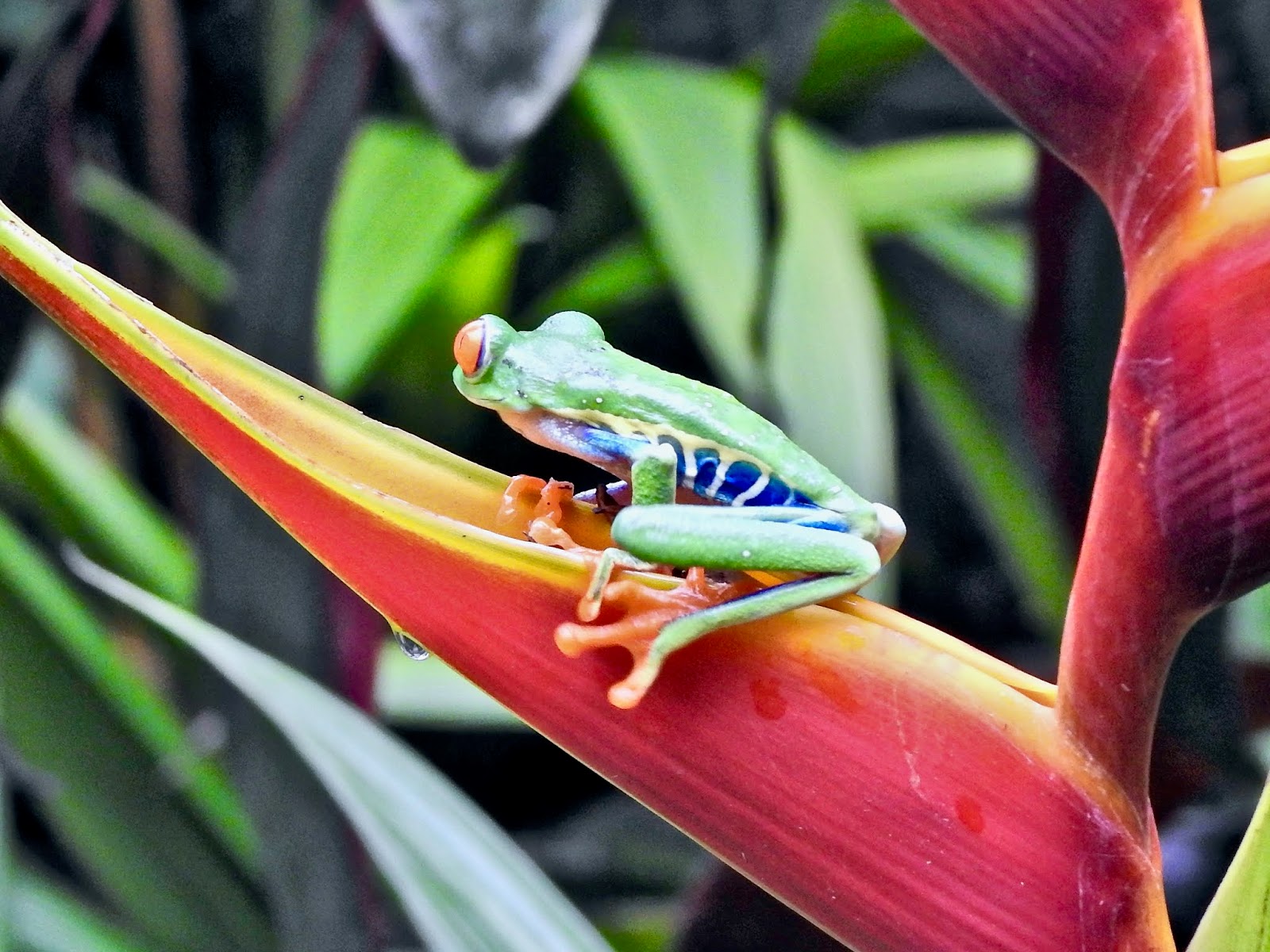
Red-eyed tree frog lives high up in trees not in a pond and is nocturnal.

Many, many hummingbirds, this is a Violet sabrewing.

This one is a Green-crowned brillant hummingbird doing a stare down with a Common chlorospingus.

Puma at the rescue center. We saw no cats in the wild. One of our guides, who leads walks everyday, said he the only cat he ever saw in the wild was a puma and only once.

Many orchids, cultivated and wild.

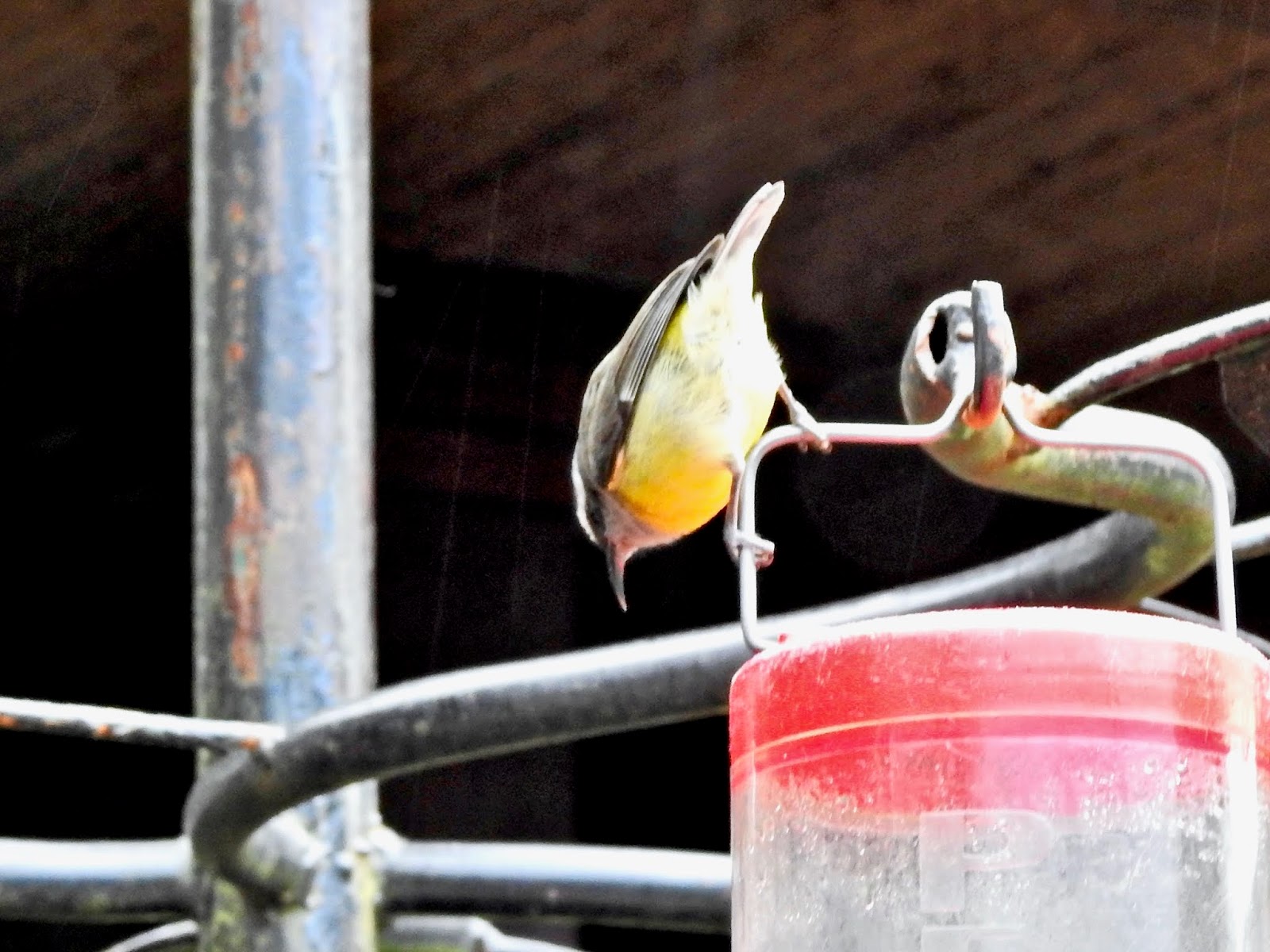
Bananaquit hangs out with the hummers.

Nat Geo sent us a plate of chocolate covered strawberries and a bottle of malbec by way of apology and offered to reimburse us for our taxi expenses.

The airport, SJO, has jetways and air conditioning, rarities in tropical airports. The cars here are mostly late models and clean, the people are friendly and English speakers readily available. Almost every house or business is enclosed in a wall or fence with gates. The unit of currency is the Colon, 600 or so to the dollar, but dollars work fine too.

After dinner at Xandari, it was off to bed. The pix below were taken the next morning.


White-crowned parrot outside our room at Xandari Resort.
The view from our room at Xandari with a Turkey vulture soaring over the valley.