Sunday, January 04, 2015

Tanzania VI.

12-26-14 SERENGETI NATIONAL PARK, TANZANIA: We had pre-dawn start to get back to the Lake Manyara Airport for our flight to the Serengeti, but still saw a genet, a small, black and white cat with a ringed tail, and a hydrax, plus giraffes, elephants and the grazers in a flying drive to the park exit.

We got to the airport, which had lost power, and we just boarded planes, no ticketing, no security, no boarding passes, just hop on for the hop. The Tanganyika Flying Company culture is relaxed when compared to the majors.

The dirt airstrip in the Serengeti, Ndutu, is manned only by a windsock and zebras. The planes make a fast approach, but don’t land and then go around for a second approach and landing. That double approach is to chase the animals off the runway.

Our new crew of guides and staff met us and gave us a quick orientation. We then took off for our first game drive in the Serengeti. The preserve is 300 square miles in area, but the animals migrate from one end to the other following the water availability and wet and dry seasons. No rain - no grass - no grazers - no prey, so everybody follows the seasons.

We almost immediately found a cheetah with two cubs. Along with ten other 4x4’s, we watched for an hour or so while she waited for some gazelles to wander within reach, but they stayed out of range. We saw a pride of seven sleeping lions before getting to the tent camp where we stay for the next three nights. Lucy asked, ‘Why did the lion cross the road?’ She answered her question, ‘To get to the other pride.’ That’s almost as bad as one of mine.

We got to Serengeti Under Canvas in time for lunch. The camp is all tents, luxurious tents to be sure, but the whole camp can be moved to wherever the animals are. The individual tents are screened because of the bugs, and the screens open with big zippers. The showers are outdoors and are large canvas buckets filled by the tent’s butler. Stephen was our butler. He also did the night escort duty for us, clean up and laundry.

There are big tents for dining and the lounge, kitchen and business offices and staff housing. Electric power is provided by generators and large storage batteries. There is lighting in the tents, and lightning outside as it’s the rainy season. Charging outlets are available at the business office. After lunch, we all napped until the afternoon game drive.

We found a leopard in a small acacia tree with part of her last kill stashed in the bushes under the tree. While we watched and photo’d her, a heavy T-storm hit, soaking the area. When we decided to move on, we couldn’t. The trucks were all mired in mud. Ultimately we got rescued while the leopard watched from her bushy lair where she had her stash, and where she sheltered from the rain.

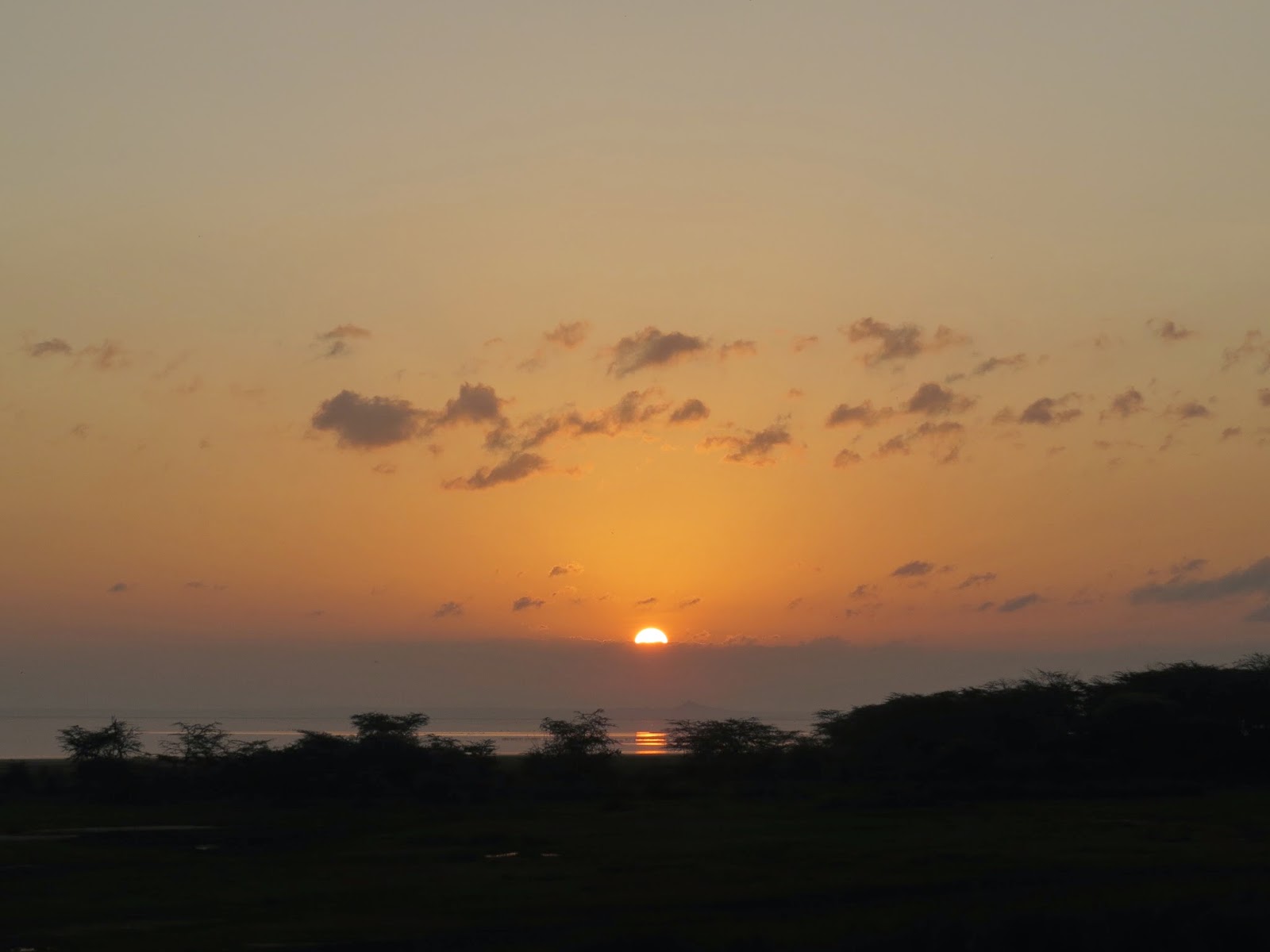
While we were waiting for help, there was a gorgeous sunset. We got back to the camp for showers, dinner and bed.

Dawn over Lake Manyara as we sped to the airport....

But stopping for pix of a Hydrax. I never heard of them either. There are seven species that live in trees or rocks. They are vegans. They weigh in at 8-10 pounds.

The Serengeti looks like this. Lots of acacia trees, flattop and umbrella, growing thickly in some places and sparsely in others. There is other vegetation, of course.

Our first Cheetah mom with two cubs...

The cubs. Did I hear somebody say 'cute'?

Marabou stork, a huge bird who was often scavenging around the camp.

Bigger Prides than we have seen before.

Roughing it in tents...

Our veranda...

A shower for each of us fill after the game drive by our butler.

Superb Starling is gorgeous and on almost every tree.

Our first leopard in her tree.

We were caught in an intense [no pun intended] rain storm while under the leopard tree. All three trucks were stuck, and the guides couldn't get us out. We were picked up by other trucks and brought to camp. They then went back to get our stuck trucks out.

Mired in the mud.

Rewarded with a sunset.

Saturday, January 03, 2015

Tanzania V.

12-25-14 LAKE MANYARA NATIONAL PARK, TANZANIA: We started the game drive after Xmas breakfast. We drove and walked along the sandy shore of the lake. Flamingos, perhaps a million, live in the lake—pink covers the horizon. Zebras, cape buffaloes, wildebeests, gazelles, impalas, birds, butterflies all live on the lake shore and in the surrounding forest. The lake is quite large, but very shallow. The flamingoes a few hundred yards off shore were only in ankle deep water.

The lake sits on the East Africa rift zone. The continent of Africa is very slowly splitting apart. The eastern twenty percent of the continent may separate from the rest just as Madagascar did 90 or so million years ago, or not, if the rift fails to open further.

Near the park entrance, the roads are the same red, crushed basalt we had been seeing elsewhere. The southern part of the park is different. The soil and roads are sandy.

Away from the lake to the west, the park is bounded by a long, steep igneous escarpment created by the rifting. The part of this wall near the lodge is plutonic as opposed to volcanic. Magma rose from the earth’s mantle because of the thinning of the crust caused by the rifting, but didn’t erupt in volcanic fashion, but instead slowly cooled deep within the crust, forming granite. The pluton reached the surface after the overlying rock was eroded away. Later, a huge section of the pluton broke away and littered much of the lakeshore with huge boulders. Sand, the ultimate erosion product, is the end result of the granite breakdown.

Hot springs, another manifestation of crustal thinning, are present along this part of the lakeshore. On the way back to the lodge for lunch, we saw two klipspringers, little gazelles that spring from rock to rock, well suited to this boulder strewn area.

After lunch, some of us hit the lodge’s swimming pool before the afternoon excursion. We saw some elephants and several sausage trees which have large, heavy, grey sausage shaped fruits, hence the name. Around the lodge the mahogany trees dominate, and their wood is used for much of the local construction including the decks at the cabins. The northern part of the park has lots of baobab trees. They have giant, soft wood trunks and a rounded crown. The guides say you can estimate the age of these trees by joining hands and forming a circle around the tree to measure them in people units. Each person equals a century of growth.

The afternoon drive ended on the beach by the lake where a local church choir gave us a concert of Swahili Christmas songs with dances. We reciprocated with a pathetic version of “Jingle Bells”, part of one verse of “We Wish You a Merry Christmas” and Maggie, our singer, did “Hallelujah” and the rest of joined in on the chorus. The lodge staff provided food, and we later made a donation to the church for musical instruments. On the way back to the camp, we were soaked by a hard rain.

After dinner at the lodge, Anna, Joe and Lucy were tapped by the camp staff to judge a ‘Manyara’s Got Talent’ contest, and Judy was the MC. We did a very impromptu version of some of “New York, New York” after all the contestants performed. The acts were mostly parodies, but were all done with enthusiasm. Enthusiasm is the one word that describes all the staff and all the lodges we stayed at in Tanzania. Judy and I have been to lots of hotels and resorts in many countries, but have never seen as much enthusiasm as we see here.


Lake Manyara Tree Lodge.

Our tree house, the stuff over the bed is mosquito netting lowered at night.

Many many many flamingoes.

Zebras and flamingoes.

Tanzanian monarchs.

Little Bee Eater.

Flamingoes on the move.

Lion at siesta.

Giraffe, check out the eyelashes.

Klipspringer is a small antelope that lives among boulders as habitat.

Hamerkop has a big crest on the back of the head that he isn't showing.

Brown-Hooded Kingfisher.

Elephants working on the grass.

Rainstorm on the way.

Friday, January 02, 2015

Tanzania IV.

12-24-14 LAKE MANYARA NATIONAL PARK, TANZANIA: We left the crater after breakfast, driven by our guides. Baboons blocked the road for a while, but gave way as we inched forward. We drove back to airport at Lake Manyara.

The guides from the Lake Manyara Tree Lodge picked us up, and we did a game drive on our way to that lodge. We saw blue monkeys, baboons, wildebeests, zebras, gazelles, hippos, lots of birds and butterflies. Lunch was at a picnic area with many new birds. In the afternoon, we saw our first giraffes and more elephants, dik-diks, miniature gazelles, and tortoises.

 The Tree Lodge, has an open central lounge and dining space and widely scattered and separated ‘tree houses’, in the jungle, a mahogany forest. The cabins are open except for screening, with a big deck and an outdoor shower, all the houses are on stilts, one story off the ground. The lodge property is not fenced and large, wild animals may wander through requiring a Maasai escort back and forth from the cabin after dark.

The lake, like the lake in the Ngorongoro crater, is salty. Both lakes have no outlet. They fill during the rainy season from runoff that contains minerals that accumulate in the lake. During the dry season the water evaporates and the lakes partially dry up but the minerals remain. The lakes are alkaline from the minerals and the water is not potable, but does support blue-green algae growth that the flamingoes eat. Lake Manyara covers 90 sq. miles when full but is very shallow.

After an outdoor dinner in a torch lit clearing, there was a big Christmas Eve show with native dancers and musicians. Our tired campers gradually drifted off to bed during the show.


Baboons taking over the rim road at Ngorongoro.

Baobab tree with massive, soft wood trunk.

Silver-cheeked hornbill.

Blue Monkey.

Butterfly - citrus swallowtail?

Impala buck, the females have no horns.

Vervet Monkey. The male has a distinctive feature.

Black Winged Stilt the male is in back.

Hippos share the ponds with water birds.

We saw our first giraffes here, lots of them.

Giraffe and zebra.

Elephants with baby.

Waterfall down the escarpment. The water is headed for the lake.

Thursday, January 01, 2015

Tanzania III.

12-23-14 NGORONGORO CRATER, TANZANIA: We had a predawn start, 6 AM, for another crater drive. We had a bright orange sunrise while on the rim road with views of Mt. Kilimanjaro above the eastern crater rim. We are in the rainy season now with cloudy skies, and the staff said views of the mountain happen about once a month. This game drive was in different areas of the crater—elephants, lions, rhinos, hippos, birds, gazelles, zebras, lots of baby animals, monkeys, baboons, wildebeests. The wildebeests blocked the road a one point and Maggie said it was, ‘Occupy Ngorongoro.’

The breakfast break was at about ten AM in the crater at a pond site, Ngoitokitok Springs, where we could walk around, and where I got sunburnt. The pond was filled with hippos and water birds. By noon there was a T-storm, while we had lunch back at the lodge. Baboons visited the lodge site after the rain, eating flying termites that appeared with the rain.

The area around the Ngorongoro Crater is the Ngorongoro Conservation Area, and it is overseen by a supervising Authority. The abbreviation for that body is NCAA. It has a familiar sound for some reason.

In the late afternoon, we visited a Maasai village. The Maasai are semi-nomadic herders who keep sheep, goats and cattle, defending the herds from lions and other predators with spears. The village is encircled by a stockade fence with a stock corral in the center. Houses line the inside of the fence.

We were greeted by a dance by the men of the village to singing by the women. We toured the houses, the school, bought trinkets. Judy had brought school supplies for the children. The houses are round, mud walled, domed and dark inside. There is a fire site in the kitchen, beds for the parents and beds for the children and a cage for calves or lambs. The house is twenty feet in diameter. Eoin and Joe tried spear throwing after a lesson. Our guide, Peter, told us about Maasai lion hunting from his personal experience, a ritual no longer practiced.

Then we had dinner at the long table in the dining room and off to bed.


Early sunrise.

Sun reflected by Lake Magadi on the floor of the crater as we begin our descent. That lake is salty due to the accumulation of volcanic minerals, and so supports the flamingo population.

Thomson's Gazelle with calf.

Male simba.

Elephant eating Acacia branches and oblivious of the thorns.

Vervet Monkeys and baby.

Kori Bustard.

Another Lion, young male.

Dispute between behemoths.

Black Rhino.

Hippo and Grey Heron.

Eland.

Maasai village school with visiting student.

Crater Lodge cabins, it's cold at night, and a fire helps, hence those chimneys.