Thursday, May 12, 2016

Mediterranean Cruise Day V.

5-5-15 BONIFACIO, CORSICA, FRANCE: We were docked in the harbor, literally, at the crack of dawn. In fact a lot of us were up at 6AM for the sunrise in Bonifacio. The harbor is long and narrow and sits in a ravine with tall, chalky-white limestone cliffs on each side. The town sits on top of the western cliffs. The upper town is called the Citadel. The town walls are largely intact and dotted with round forts at regular intervals. There are also lots of shops and restaurants at the harbor level. The sun put in an appearance at about 6:20.

After breakfast, we caught a tourist ‘train’ ride up the hill for a tour of the town. It is another one with narrow, twisting streets lined by stone, stucco buildings, a bunch of churches, a military statue, many bistros and souvenir shops. None of the streets are level, everything is either up or down and some of the streets are stairs. The east side of town cliff has stairs and a road with sharp cutbacks for access, but on the west side of town cliff is precipitously steep. The town is only a few blocks wide, from cliff to cliff. There are great views in every direction of the white, limestone cliffs and the sea and Sardinia in the distance. Several massive chunks of limestone have fallen from the cliffs into the sea.

We followed our talky guide for a while before sneaking off on our own. The less settled areas of town have profuse beds of wild flowers, especially around the cemetery. Eventually we walked down the cliff on several different sets of stairs that dumped us out near the ship in time for lunch.

After lunch in the sun on the afterdeck, we had a Zodiac cruise of the cliffs and saw them from the water. There were numerous caves and grottos, very clear water, and the several huge hunks of cliff that had fallen into the water. We saw a group of teens, some of whom dove into the water to impress us from chunks of cliff a few feet above the water. We were impressed a little. Before getting back to the ship, we met a Zodiac staffed by the ship’s bartenders anchored in an inlet with a pretty beach. Strawberry margaritas were served to the thirsty.

Dinner was at a harbor-side restaurant, Di Passano, with a wine tasting and a tapas style meal. We were entertained by a six man, polyphonic a cappella group, Le Choeur de Sartène, doing traditional music.


Bonfascio, Corsica, France harbor awaiting sunrise.

Sunrise at the Citadel in Bonfascio on top of the cliff, but not down at the harbor yet.

Uphill street or downhill street, depending.

Obligatory military-triumph statue.

Downhill street

Limestone cliffs.

Limestone bedrock erodes easily making inlets with white, sandy beaches.


The citadel and walls.

Wild poppies.

Cliff divers.

Does that last house look like a good investment?

walkway on the cliff near the water.

Wednesday, May 11, 2016

Mediterranean Cruise Day IV.

5-4-16 ALGHERO, SARDINIA, ITALY: We cruised overnight and through the morning headed eastward leaving Spain behind and entering Sardinia and Italy, specifically at Alghero, in the northwest corner of the island. The planned Zodiac trip to Neptune’s grotto, a big cave eroded out of the limestone bed rock by sea action and rain, had to be cancelled because of sea conditions. We opted to send the afternoon walking around Alghero, dropping our gracias for grazie.

The city is on the edge of the sea with a long sea wall extending into the bay to create a sheltered harbor. The sea wall was part of the town’s fortifications. They display old cannons and catapults inside the wall. There are also lots of outdoor cafés and restaurants along the street just inside the wall.

Extensive beds of a purple succulent flower grow on and out of the wall. In one spot, in front of a restaurant, the beds cover the whole front yard and were visible from the ship. We saw lots of churches, entered a few. We shopped for earrings, Judy, gelato, both of us, T-shirts, Judy, and walked the narrow streets and broad avenues and the harbor.

At about 5 PM we Zodiaced back to the ship, and soon set out for Corsica. In the old days before the Euro we would have had to change our dollars for pesetas, then liras, and then francs.


Alghero, Sardinia from the sea.

Walls and flowers,

A chance to buy some red.

Tiled dome.

Under the dome.

Sea wall and purple succulent.

The town folks must feel quite secure with defensive machines like this catapult.

Two forts and the old town.

Is that too much purple? This yard was visible from the ship.

Gelatateria,

The oldest parts of the wall need work.

Tuesday, May 10, 2016

Mediterranean Cruise Day III.

5-10-16 SHORT HILLS: Everything in the yard is leafing out. Yesterday afternoon was hot and last night cool.

New blooms: ajuga, Siebold viburnum, double file viburnum, first rhododendron, chestnut, bridal wreath spirea, columbine.

5-3-16 MAHÓN, MENORCA, SPAIN: While Judy went on a hike labeled as moderate that turned out to be hard, I stayed on the ship dealing with a gastroenteritis that cleared up almost as soon as the ship emptied out. All the other explorers went on various activities. I had the morning to catch up on crossword puzzles, help the captain steer the ship when I was on the bridge, and take some pix of the journey from Ciutadella on the western end of Menorca to Mahón on the eastern end. Mahón is about a mile up an estuary from the coast through heavily settled newish neighborhoods. We motored to the dock at the base of the old town.

The whole southern half of Menorca is limestone [and possibly some dolomite] uplifted when the African plate collided with and subducted under the European plate, thereby lifting it upwards. This tectonic interaction created the Betic Cordillera, mountains of southern Spain, of which the Balearic Islands are the eastern extension. Limestone is the stuff of coral reefs, and so is formed in the ocean and dissolves, very slowly, when raised up out of the water. In the air, rain and waves eat away at the limestone and create caves and ultimately canyons.

Mahón is located atop large limestone deposits, guesstimate 100 feet high. The center of the old city is reached by successive flights of stone steps from the water’s edge to the city streets, going up a canyon in the limestone. There are somewhere between 107 and 150 steps depending on which way you go. After the ship docked at the base of the steps, I climbed to the town.

Mahón, old city, is a sleepy, sun-drenched town of pastel buildings with shuttered windows at mid-day. All the ground floors are shops selling all the stuff tourists buy, like the T-shirt I bought. There are Romanesque churches, crumbling fortifications, an opera house, narrow, cobblestone streets, an old town hall, plaças, museums and lots of outdoor bodegas. After a couple hours of wandering and watching the birds from the heights, I went back to the ship and found and joined Judy and part of her hiking group heading off for an archeological visit to Talaiòtic sites a short bus ride away.

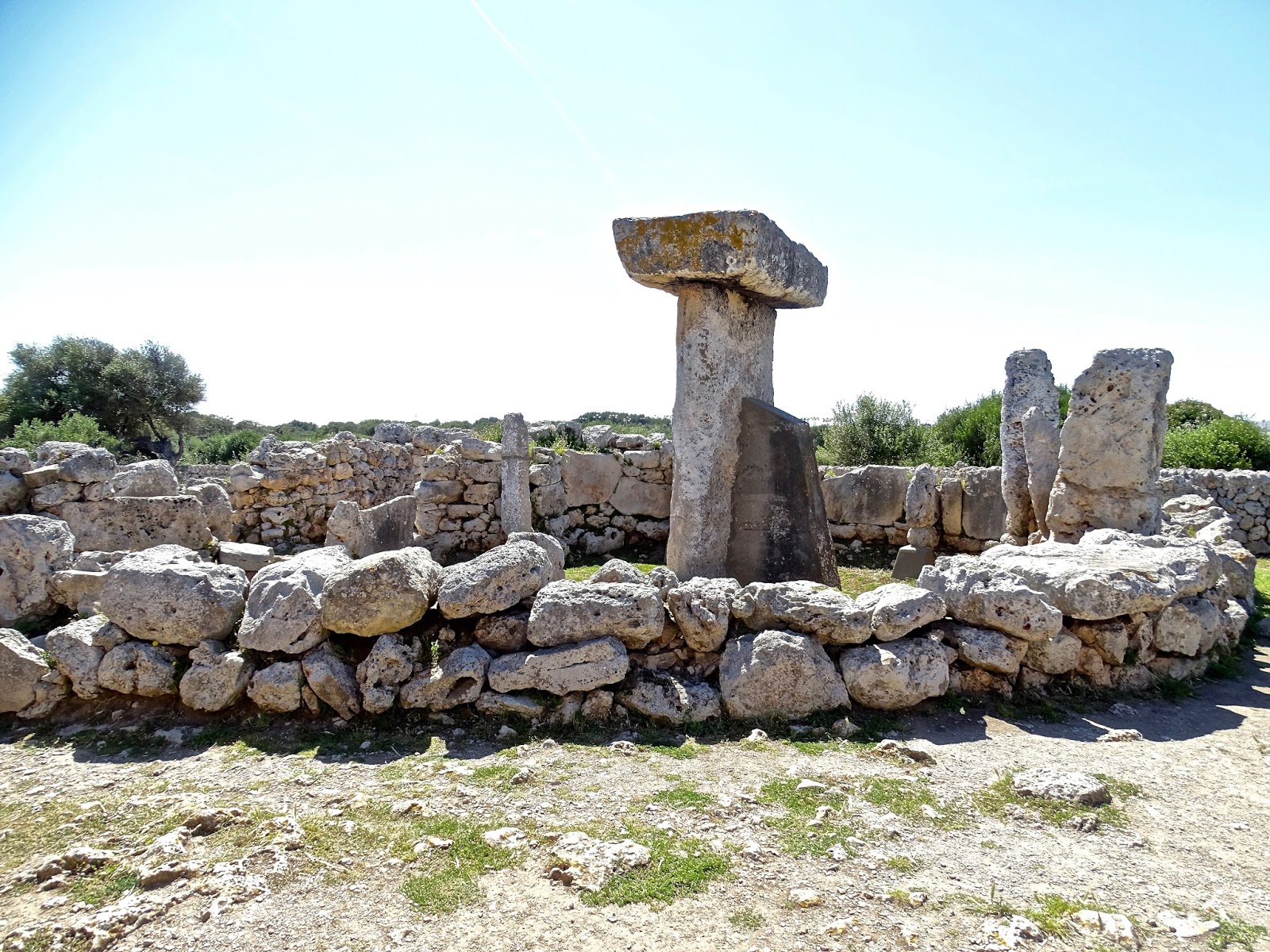
The site is up country in the midst of farms and olive groves and many limestone walls. Fallow fields are full of wild flowers. The Talaiòtic Culture existed during the Iron Age and left limestone mounds built of boulders, twenty or so feet high and fifty feet wide of unknown function. There are standing stones capped with horizontal slabs and remains of circular houses. The site we were at held perhaps 500 people.

Finally we were back at the ship for dinner and set sail on to Sardinia. There was a nice sunset. Judy and I and Australian friends Melanie and Dale dined with Craig, the ship’s Hotel Manager. During dessert, we revealed our porn-star names, which are derived from the name of one’s first or favorite pet and the name of a street lived on in childhood. I became Jolly Parkway, which caused extreme hysteria at the table and Craig got me a new nametag for my new alias.


Mahón waterfront and town atop the limestone cliffs on both sides of the picture. The gap in the cliffs, erosional in origin, allows the stairs and road to climb up to the town.

From the top of the climb, the Orion in the harbor.

Back-lit organ.

Theatre muse draws some attention.

One of several little plazas amid the pastel buildings.

Another plaza paved with limestone.

A different church interior.

From Judy's hike - limestone  and clear water, lots of little caves at the water level.

A beach on the hike with native fauna.

Menorca Talaiòtica, entrance to the site with limestone wall and great gate.

Talaiòtica stone mound of unknown function, perhaps watch tower or storehouse?

Talaiòtica standing stones and cap, all of considerable mass.

Wall, reconstructed, and olive tree, probably as old as the site.

Limestone erosion along the coast. Remember: all the limestone in these pix was formed under water and later uplifted.

Monday, May 09, 2016

Mediterranean Cruise II.

5-9-16 SHORT HILLS: We are back in NJ and reunited with the furry friends. Here is Day II.

5-2-16 CIUTADELLA, MENORCA, SPAIN: At first light the ship was pitching and rolling significantly. We had left Barcelona after dinner the night before to gentle rocking. Out our cabin window the steep, rugged, craggy peaks of Mallorca drifted by. The steep terrain is only occasionally punctuated by scruffy vegetation. The capital of the Balearic Islands, Palma, was visible in the distance. The city sits at the end of a bay on a plain between mountains. We made our way to Menorca, 35 miles to the east, through moderately rough seas. Breakfast was poorly attended.

By lunchtime we were in the lee of Menorca, and the ship was much steadier. There were lectures on the Balearics and birds during the day. In the late afternoon we Zodiaced to shore and had a tour of the city of Ciutadella. The city is on the western end of the small island. The bedrock and most of the buildings are limestone. The island’s history goes back to pre-historic times and almost everybody has had a piece of the action, including the Phoenicians, Greeks, Carthaginians, Romans, Vandals, various pirates, Moors, Turks, Byzantines, English and finally the Spanish.

We saw the old Plaça des Born, churches, the Cathedral, Casa Olivar, a restored 18th century house, palaces, shopping, and the harbor before heading back to the ship by Zodiac for dinner. The food has been excellent and the bar open at all times.


Mallorca through the morning fog and mist.

Ciutadella de Menorca harbor. The stuff growing out of the wall is mostly capers.

Town Hall, Ciutadella.

Capers gone wild.

Crest over the door of a palace. Palace is used to describe any large house.

Bell tower.

Plaça des Born.

Cathedral interior.

Casa Olivar dining room.

Rehearsing for her first communion.

Visit to the bridge and Captain.

Sunday, May 08, 2016

Mediterranean Cruise I

5-8-16 NICE, FRANCE: We are off the ship and in Nice in our Hotel Marriott Boscolo Exedra with lightening-like WiFi so I will begin the trip reports with our First Day at sea...

5-1-16 MEDITERRANEAN SEA: At the end of the day we left Barcelona Harbor on the Orion after dinner.

Earlier we had slept in to deal with jet lag, hit the neighborhood caffé, for breakfast, saving about $100 compared to the hotel breakfast. Then we checked in with Nat Geo at the Majestic and did a morning stroll to see another Gaudí house in the area.

Then it was on the buses for a city tour before the ship. We saw the Olympic facilities from 1992 converted to local uses, a retired factory converted to exhibit space, a bullring, bull fighting being outlawed in Catalonia, converted to a shopping mall. After seeing the top of the mountain on the coast overlooking the city, to which we returned later in the day, we checked in at the ship for lunch and an emergency drill and intro to ship life.

The ship is very luxe with spacious cabins and facilities. After an alfresco lunch on the after deck, we were back in the buses for more of Barcelona, covering some of the same ground we had seen before but stopping on top of the mountain, Montjuïc, or Jewish Mountain, so called for a medieval synagogue on the mountain top. That was at a time when Jews, Christians and Muslims lived in harmony in Spain before the reign of Ferdinand and Isabella.

The views are of the entire coast, city, harbor which is extensive, running for miles along the Med coast and includes the airport. We saw distant mountains to the east, perhaps even the Pyrenees. After a short walk around the top of the mountain, we heard a presentation of Flamenco music by La Nave Bruja. Then it was back to the ship for ‘tails and dinner.


Nat Geo/Lindblad ship Orion in Barcelona harbor.

Our cabin with lots of electric outlets for US plugs, TV that gets MSNBC.

From the mountain the Barcelona Cathedral in the old city.

The Orion next to a 'real' cruise ship.

Cactus flower.

Mountain top Flamenco players, La Nave Bruja.

Flamenco singer dancer. See Facebook for a short video of the performance.